

How Panpsychism Avoids Being Wrong (A Quick Primer)
The Retreat Protocol and the usefulness of the Hard Problem of Consciousness

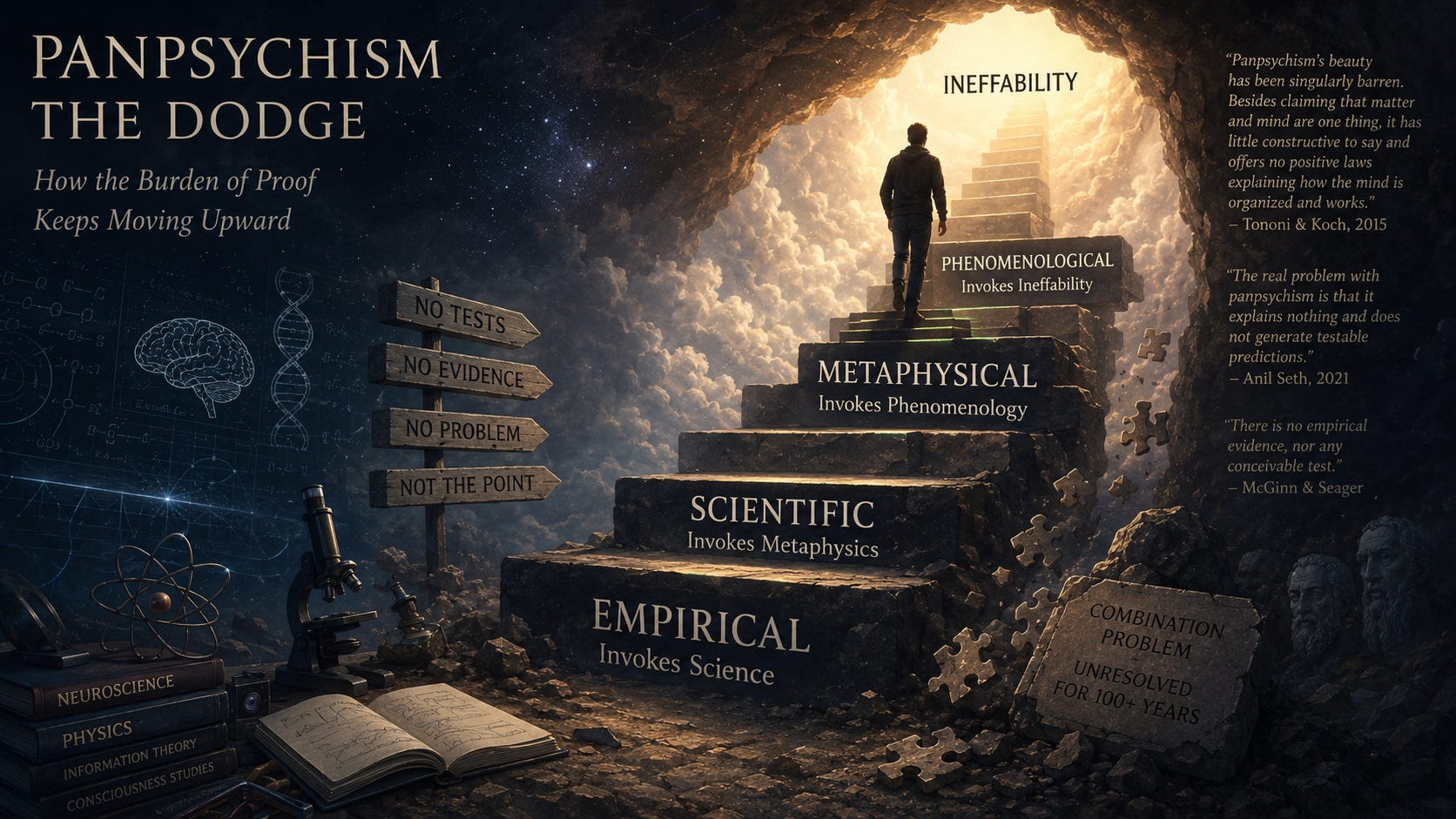
The Retreat Protocol and the usefulness of the Hard Problem of Consciousness
Abstract
Panpsychism avoids falsification by shifting explanatory registers whenever empirical constraints are applied. It remains stable under critique by moving between scientific language, metaphysical framing, and phenomenological interpretation without producing a consistent set of conditions under which it would fail at any of those levels. This is not just a limitation of scientific underdetermination but a constructed false dichotomy that exploits the unfalsifiable assumed premise in the so-called “Hard Problem of Consciousness.”
Opening Question: What Would It Take for This View to Fail?
We are often invited to treat panpsychism as a theory of consciousness. A more basic question comes first. What would it take for it to be wrong?
What observation would force rejection rather than reinterpretation?
What experiment would distinguish it from competing accounts in a way that could not be absorbed by a shift in framing?
At what point does a claim stop answering to the world it describes and begin to depend on adjustments in description when pressure builds?
These questions are not rhetorical flourishes. They define the minimum conditions for empirical responsibility.
When panpsychism is asked for those conditions, something consistent happens in the structure of the reply.
It does not fail. It relocates.
Register Shifting and the Problem of Falsification
When panpsychism is pressed for empirical criteria, it tends to adopt scientific language. When asked for predictions in that register, it moves toward metaphysical framing. When that is pressed further, phenomenology enters the picture. When that runs out of traction, ineffability becomes the final reference point.
Each step has internal coherence. The issue is what happens across steps.
The Internet Encyclopedia of Philosophy describes panpsychism as “a kind of meta-theory of mind,” while the Stanford Encyclopedia of Philosophy characterizes it as the view that mentality is “fundamental and ubiquitous” in nature. Taken together, these do not fix a single level of description. They permit movement between levels depending on where critique lands.
Scientific authority often appears when it strengthens plausibility, then recedes when empirical constraint is requested.
The structure that remains is difficult to place under stable test conditions. This is a textbook motte-and-bailey structure: Register shifting undermines falsification because each explanatory register introduces its own standards of adequacy while dropping the loss conditions that applied in the previous one. Panpsychism can appear scientifically aligned when framed in empirical language, then reappear as metaphysical necessity or phenomenological primacy when predictive demands are introduced, and finally retreat into ineffability when further constraint is applied, with each move internally coherent but collectively non-convergent on a single testable domain. The result is a framework that remains locally defensible at every step, while globally avoiding any stable condition under which failure can accumulate or register as disconfirmation.
Permanently leaving no principled criterion by which it could be revised through engagement with reality or adjusted by evidence.
Flew’s Criterion and Claims Built to Absorb Every Outcome
Anthony Flew’s discussion of unfalsifiable claims isolates a structural failure mode in epistemology: a statement that remains compatible with every possible state of affairs ceases to function as a claim about reality.
The parable tradition around this includes Russell’s teapot, Sagan’s dragon in the garage, Flew’s invisible gardener, and Last Thursdayism. Each describes a different surface narrative, but the underlying structure is identical. No possible observation forces revision because every observation is reinterpreted inside the theory.
The critical distinction is not between observable and unobservable.
It is between claims that generate discriminatory constraints and claims that absorb all outcomes without loss.
Axioms in formal systems avoid this problem because they do not pretend to compete as empirical descriptions. They generate consequences once fixed. The issue appears when a framework presents itself as describing the world while remaining invariant under every possible observation of that world.
That is the relevant failure mode here.
Evidence, Constraint, and the Segall Shift
A recurring move in consciousness debates involves a shift in what “evidence” means.
At one level, evidence refers to public, intersubjectively checkable constraints that distinguish models. At another level, it is narrowed to direct presentation of a target object. When that narrowing occurs, the conclusion “no scientific evidence exists” becomes structurally guaranteed.
This is the key pressure point.
If evidence must mean “direct appearance of consciousness as a separable object,” then the claim is defined into immunity.
If evidence means “stable, intervention-sensitive constraints on report, behavior, and neural dynamics that discriminate models,” then the claim collapses under existing neuroscience.
The ambiguity is not incidental. It is structurally productive.
Whitehead, Process, and the Bifurcation Problem
Whitehead’s process philosophy is often invoked as the metaphysical background for these positions. His critique of substance metaphysics targets the assumption that reality is made of inert objects that occasionally interact.
He also rejects what he calls the bifurcation of nature, where subjective experience and objective measurement are treated as ontologically separate domains.
The Whiteheadian move is internally coherent. It replaces static substance with relational process and event structure.
The question is not whether this is coherent.
The question is whether it generates discriminating empirical constraints.
What Segall Gets Right About Evidence, and Where the Pressure Builds
A crucial correction must be preserved.
Scientific evidence is not raw sensory data. It is theory-laden, model-mediated, and dependent on instrumentation and interpretation. No observation arrives without assumptions embedded in measurement systems.
This point is correct.
The inference that sometimes follows is where tension appears. The move from “all evidence is theory-mediated” to “therefore some domains are not subject to empirical constraint” does not follow.
Many successful scientific domains operate entirely within theory-mediated inference. They treat unobservables as constrained by intervention, covariance, and cross-validation across methods.
Consciousness research already operates this way.
The question becomes whether metaphysical claims about consciousness add further constraint or dissolve it.
Combination Problem and Persistent Underdetermination
Panpsychism faces a long-standing structural issue known as the combination problem. The difficulty concerns how micro-level experiential properties relate to macro-level conscious states.
Despite extensive refinement in the literature, no consensus mechanism produces clear discriminating predictions that separate panpsychism from mechanistic or functionalist accounts.
This produces a stable form of underdetermination.
Different metaphysical interpretations remain compatible with the same observational space.
That compatibility is not neutral. It reduces the ability of the framework to function as a rival explanatory system.
Scientific Language, Metaphysical Framing, Phenomenological Closure
At the empirical level, scientific terminology is invoked.
At the scientific level, metaphysical interpretation enters.
At the metaphysical level, phenomenology is invoked.
At the phenomenological level, ineffability appears.
Each layer is defensible locally. Across layers, the structure allows the same claim to migrate depending on where constraint pressure appears.
The persistence of the core thesis across shifting evaluative contexts is the key feature.
Neuroscience and the Constraint Map
Tononi and Koch describe panpsychism as “singularly barren” in explanatory output. The concern is not dismissal of consciousness, but lack of discriminating structure.
Anil Seth similarly argues that it “explains nothing and does not generate testable predictions,” characterizing it as an “easy get-out” from the hard problem.
The shared concern is not metaphysical disagreement. It is absence of failure conditions.
The “Not Testable” Problem and the Return of Analogy
McGinn and Seager identify a structural limit case: no conceivable test appears to discriminate mentality in simpler systems under certain formulations.
When this position is adopted strongly, analogy and continuity become the primary tools of justification.
Analogy can extend interpretation.
It does not generate separation between competing models that share identical constraint profiles.
This is where underdetermination becomes stable rather than transitional.
Lakatos and Protective Structure
Lakatos’s framework describes research programmes with a hard core protected by auxiliary hypotheses.
The SEP summary distinguishes progressive programmes, which generate novel predictive content, from degenerative ones, which primarily absorb anomalies.
In the panpsychist case, the combination problem persists while auxiliary structures expand: intrinsic nature, neutral monism, process ontology, proto-experience, constitutive relations.
The overall effect is accumulation of interpretive scaffolding without clear empirical discrimination.
Constraint Failure Modes: Equivocation, Motte and Bailey, Self Sealing Moves
Several structural vulnerabilities appear repeatedly in consciousness metaphysics debates.
Equivocation occurs when “consciousness” shifts between reportable access and ubiquitous interiority without explicit separation.
Motte and bailey structure appears when a modest claim about experience is used to support a broader metaphysical claim, then the broader claim is withdrawn under pressure.
Category errors arise when evidence is restricted to direct object detection rather than intervention-sensitive constraint mapping.
Self sealing moves occur when a claim is defined so that any possible counterevidence is reinterpreted as irrelevant by definition.
These are not rhetorical failures. They are structural stability strategies under constraint pressure.
Loss Conditions and Explanatory Immunity
Panpsychism avoids loss conditions by shifting explanatory registers whenever empirical constraints are applied. It remains stable under critique by moving between scientific language, metaphysical framing, and phenomenological interpretation without producing a consistent set of conditions under which it would fail at any of those levels.
This does not arise from a limitation of scientific underdetermination so much as from a prior partitioning of the problem space.
The “Hard Problem of Consciousness” is treated as inherently exempt from the kinds of constraint that normally define when a theory loses contact with reality.
Once that exemption is accepted, empirical underdetermination is no longer a sign of weakness or failure condition. It becomes a structural feature of the framework itself, because no possible observation is allowed to register as a decisive breakdown in the claim’s applicability.
Flew, Sagan, Russell, and the Problem of Immunized Claims
Antony Flew’s criterion isolates a specific epistemic boundary: if no possible state of affairs counts against a claim, then no state of affairs confirms it in a discriminating way. The invisible gardener illustrates this structure in concrete form. If a garden is said to be maintained by an unseen agent that leaves no trace, produces no observable difference from unguided growth, and remains compatible with every possible state of affairs, then every attempted test is absorbed without residue. In that setup, the claim does not fail under any observation, but only because no observation is allowed to register as a potential failure condition in the first place. The result is that “gardener exists” and “gardener does not exist” no longer correspond to distinct expectations about what the world should do, which removes the asymmetry required for the claim to function as a discriminating statement about reality.
Bertrand Russell’s teapot is a compressed illustration of the same structure. A teapot orbiting between Earth and Mars is not disprovable in any practical sense if the claim is continuously adjusted to evade detection thresholds. The point is not that such a teapot is logically impossible, but that insulating it from all possible observational leverage removes any difference between “true” and “false” states in practice. Once every potential detection method is pre-emptively neutralized, the claim no longer participates in ordinary inferential constraint, even if it is framed in empirical language.
Carl Sagan’s dragon in the garage extends this by adding adaptive shielding through reinterpretation. If every proposed test of the dragon is met with a new modification, invisible, intangible, heatless, and so on, then the hypothesis survives by absorbing all possible failure modes into its own definition. What appears to be a living claim about the world becomes a moving target that changes shape exactly at the point where observation would otherwise introduce constraint. The result is a structure that preserves verbal coherence while eliminating any stable condition under which it could be wrong.
Last Thursdayism, the idea that the universe could have been created last Thursday with all apparent memories, records, and historical traces generated already in place, shows that temporal embedding does not introduce constraint if all evidence is pre-interpreted within the hypothesis itself. If every observation, including apparent memory of a past, is produced by the same generating process that asserts the theory, then nothing in time can function as a loss condition, because no possible experience or record can fall outside the model’s own generative structure.
The issue is not plausibility. It is constraint independence.
A claim that cannot lose contact with reality has also lost the capacity to be distinguished by it.
Where Segall’s Strongest Argument Applies, and Where It Stops
The strongest Segall-style argument is epistemological: all evidence is mediated, interpretation is unavoidable, and naive empiricism fails.
This holds.
The extension of that claim into exemption from empirical constraint does not follow.
Interpretation does not remove constraint. It relocates it into model comparison, intervention sensitivity, and cross-method convergence.
The question becomes whether metaphysical frameworks introduce additional constraints or simply reinterpret existing ones.
The Key Socratic Pressure Point
If consciousness is framed as a condition for the possibility of experience or evidence, then that condition applies to the claim itself.
What would count as a failure of that claim?
If nothing could, then the claim does not compete with empirical theories. It sits outside them.
If something could, then it must be specified.
That specification is the difference between interpretation and explanation.
Why Intervention Matters More Than Correlation
Correlation alone does not settle causal structure. That point is correct.
Intervention does.
In neuroscience, perturbational approaches show systematic relationships between brain dynamics and levels of consciousness across anesthesia, sleep, and disorders of consciousness.
These results produce constraint maps that discriminate between models of consciousness.
They do not require metaphysical interpretation to function.
They require only stable intervention-sensitive structure.
Recursive Constraint Falsification
The method proceeds in four moves.
First, definitions are separated into operational variants. Ambiguity is treated as data, not flexibility.
Second, claims are translated into constraint expectations rather than object-level assertions.
Third, interventions are used to test divergence between competing models.
Fourth, auxiliary assumptions are tracked explicitly so that revision does not become silent goalpost movement.
This preserves theory-ladenness without allowing exemption from constraint.
Footprint Requirement for Metaphysical Claims
Any claim about pervasive experience, intrinsic interiority, or field-like consciousness requires a distinguishable footprint in observational space.
If no such footprint exists even in principle, then the claim remains interpretive rather than empirical.
If a footprint exists, it must specify how intervention or measurement would differ across rival models.
Without this, metaphysical claims remain compatible with all possible observations.
That compatibility defines their limitation.
The Segall Question in Operational Form
If panpsychism or process metaphysics were false, what would you expect to observe differently?
If the answer is nothing, then the claim does not participate in empirical adjudication.
If the answer involves reinterpretation rather than observation, then the claim operates as a framing system rather than a predictive one.
This distinction determines whether a framework competes with scientific theories or sits alongside them.
Closing Constraint
A framework that cannot specify what would count against it does not resolve the hard problem of consciousness.
It relocates it into interpretive space where failure conditions are absent and revision is optional.
That may still be philosophically valuable.
It does not function as empirical explanation.
Across consciousness science, analytic philosophy of mind, Lakatosian philosophy of science, and naturalized metaphysics, the convergence is striking. Tononi and Koch arrived there from IIT.
Seth arrived there from neuroscience and predictive processing.
McGinn and Seager arrived there from analytic philosophy of mind.
Lakatos arrived there from the structure of research programmes.
Ladyman, Ross, and Chakravartty arrived there from naturalized metaphysics.
Different traditions. Different assumptions. Different methods. Same structural diagnosis.
A framework that preserves itself by relocating its core claims to levels where empirical loss conditions cannot reach is preserving itself from the same scrutiny that any credible claim about reality deserves, using the unfalsifiable premise snuck into the hard problem.
See my additional articles here:
Cited Sources
Chakravartty, Anjan. Scientific Ontology: Integrating Naturalized Metaphysics and Voluntarist Epistemology. Oxford University Press, 2017.
Goff, Philip. “Panpsychism.” Stanford Encyclopedia of Philosophy, substantive revision 13 May 2022.
Ladyman, James, Don Ross, David Spurrett, and John Collier. Every Thing Must Go: Metaphysics Naturalized. Oxford University Press, 2007.
Lakatos, Imre. “Imre Lakatos.” Stanford Encyclopedia of Philosophy, substantive revision 26 Apr. 2021.
Montévil, Maël, and Matteo Mossio. “Biological Organisation as Closure of Constraints.” Journal of Theoretical Biology, vol. 372, 2015, pp. 179-191.
Papineau, David. “Naturalism.” Stanford Encyclopedia of Philosophy, 2007.
Seth, Anil K. Being You: A New Science of Consciousness. Faber and Faber, 2021.
Seth, Anil K. “The Real Problem(s) with Panpsychism.” Journal of Consciousness Studies, vol. 28, nos. 9-10, 2021, pp. 52-64.
Skrbina, David. “Panpsychism.” Internet Encyclopedia of Philosophy, n.d.
Tononi, Giulio, and Christof Koch. “Consciousness: Here, There and Everywhere?” Philosophical Transactions of the Royal Society B, vol. 370, no. 1668, 2015, article 20140167.
Rudolf Carnap. “H. Tolerance, Metaphysics, and Meta-Ontology.” Stanford Encyclopedia of Philosophy, section in the entry on Rudolf Carnap.
Your critique of panpsychism exposes a broader problem in philosophy. Many claims adopt the posture of rigor while lacking meaningful loss conditions. When pressured, they shift registers: empirical claims become metaphysical, metaphysical claims become conceptual, conceptual claims become linguistic, and linguistic claims retreat into intuition or framing. The claim survives because failure is never allowed to land. None of the “important” philosophers produced theories that became necessary in the way scientific results become necessary, or even overwhelmingly agreed upon by academic philosophers. That matters. A theory that cannot lose may still orient us, but it has not won.
Panpsychism is the theory that all matter is conscious, except anaesthesia mollecules.