
Institutional Capture & Diverse Intelligence: How Unfalsifiable Metaphysics Allowed the Discovery Institute to Degenerate Levin's Bioelectricity Research Program
In defense of Michael Levin, Jacob Foster, Denis Noble, David Resnik, Michael Resnik, and the work of countless others being consumed by the ecosystem.

Read the full article with all references and links here: Institutional Capture & Diverse Intelligence: How Unfalsifiable Metaphysics Allowed The Discovery Institute to Degenerate A Vital Bioelectricity Research Program (Free!)
The institutional architecture connecting Templeton funding to Discovery Institute exploitation has victims at every node, and they are the researchers who built it: Michael Levin, Jacob Foster, Denis Noble, David Resnik, Michael Resnik, and the work of countless others being consumed by the ecosystem. Michael Levin's bioelectric findings are real. The Platonic interpretation riding them is not.
This Article Covers: Institutional Capture, Funding Pipelines, The Discovery Institute’s Exploitation of Michael Levin’s Bioelectric Research to Argue for Intelligent Design, Institutional Appropriation of Legitimate Science for Harmful & Unfalsifiable Metaphysics, The Media Amplification Problem, Fecundity Alabi, Indigenous Epistemologies and What They Actually Demonstrate, & The Pattern Which Connects
For Michael Levin, whose bioelectric empirical program deserves a theoretical home that can survive the scrutiny his data has earned. For David Resnik, whose private intellectual honesty deserved an institutional context that rewarded it. For Michael D. Resnik, whose four decades of work naturalizing mathematical epistemology are being cited in defense of the very positions that work was designed to eliminate. For Jacob Foster, whose honesty under impossible constraints taught me more about how science actually works than any paper could. And for Denis Noble, whose cardiac modeling demonstrated organizational closure decades before anyone had the vocabulary for it and who deserved a better ecosystem than the one that consumed his legacy.
This article is written to protect all of them and their immensely valuable work from the institutional capture system that is consuming itself from the inside. This is not an attack on them individually, but rather a surgery on the architecture they operate within.
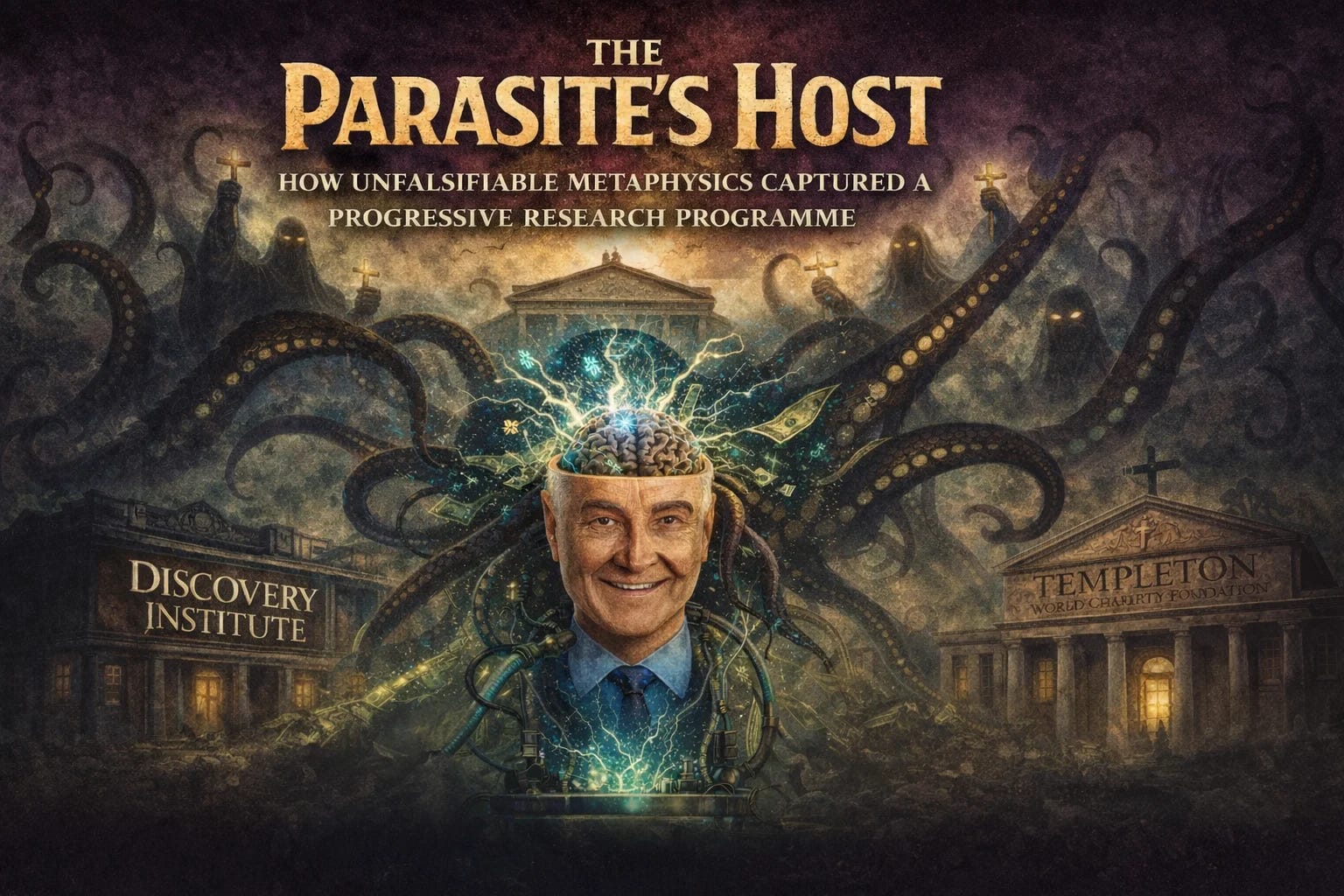
I. The Question Nobody Is Asking
Michael Levin’s bioelectric research is among the most genuinely exciting empirical programmes in contemporary biology. His laboratory has demonstrated that brief manipulation of gap junction connectivity can permanently rewrite a planarian’s body plan. His team has shown that membrane voltage potentials control embryonic eye patterning, that endogenous bioelectric gradients mediate cell-cell communication during pattern formation, and that voltage manipulation can suppress oncogene-mediated tumorigenesis at long range. These findings are real, replicable, and potentially transformative for regenerative medicine. They are why I care so much to invest so much time and effort trying to make this visible to as many scholars as I can.
What has gone almost entirely unexamined is a different question: how did a progressive empirical programme acquire a degenerating metaphysical interpretation, and what institutional architecture sustains that interpretation against the evidence of the programme’s own most structurally relevant result? Serious researchers doubt Levin’s results because of the metaphysical overreach. This has serious downstream harm.
This article traces the answer through seven layers of a self-reinforcing system: from a charity foundation’s charter mission to “enhance religious understandings of the fundamental nature of the world,” through a multimillion-dollar funding initiative that pre-encodes cognitive vocabulary into its grant criteria, through a training pipeline that socializes early-career researchers into that vocabulary before they can critique it, through editorial positions and citation networks that create the appearance of a field, through media amplification that bundles unfalsifiable metaphysics with genuine empirical findings as a single package for audiences of millions, through commercial spin-offs whose investor pitch depends on the expanded narrative, and finally to the Discovery Institute’s exploitation of the resulting language to argue that biological complexity requires non-physical explanation.
At every node in this chain, the people involved are genuine, intellectually serious, and doing some excellent work that requires none of the metaphysical superstructure attached to it. That is not a defense of the structure. It is a description of how institutional capture operates.
The argument developed here builds on and synthesizes analysis published across multiple articles on Sweet Rationalism (sweetrationalism.com), including formal treatments of the Constraint Bridge synthesis connecting Milinkovic and Aru’s biological computationalism to organizational closure theory, the documented exchange with Levin himself on his Platonic Symposium, and the predicted confirmation of every critique I raised to Levin and Resnik months before their “Mind Everywhere” paper was published.
II. What Institutional Capture Means
The term requires precision before it can be applied.
In political science and regulatory theory, institutional capture describes a process whereby public or quasi-public institutions, formally designed to serve broad societal interests, are progressively redirected to serve the interests of specific private actors or narrow constituencies. George Stigler’s foundational work in economic theory established the regulatory variant; Jon Hanson and colleagues extended the concept to what they called “deep capture,” arguing that businesses have incentives to control anything that has power over them, including media, academia, and popular culture.
The variant most relevant here is cultural or social capture, defined by the Tobin Project’s research on regulatory dynamics: “there are arguments about the cultural or social influence of repeated interaction with the regulated industry, such that the regulator begins to think like the regulated and cannot easily conceive another way of approaching its problems.” The critical feature, and the one that distinguishes capture from conspiracy, is the next clause: “the legislator or agency may not be fully conscious or aware of the extent to which its behavior has been captured.”
Ideological capture adds another dimension: institutions adopt a particular worldview or agenda, often excluding dissenting perspectives, not through overt suppression but through the accumulated weight of vocabulary, funding criteria, training protocols, and social incentives that make alternatives progressively harder to articulate, let alone pursue.
I want to be precise about what this analysis does and does not claim. It does not claim Michael Levin is dishonest. The empirical work is real and important. It does not claim conscious conspiracy at any level. It does not claim that Templeton funding automatically invalidates research; many excellent researchers receive Templeton grants. What it claims is that there exists a structurally self-reinforcing system in which funding incentives, editorial positions, citation networks, media amplification, commercial interests, and vocabulary choices align in ways that systematically reduce the epistemic pressure on the framework’s unfalsifiable components. By the definitions in the peer-reviewed literature, that is institutional capture applied to an academic research programme.
A methodological note on intent deserves emphasis, because the temptation to psychologize will be strong throughout what follows. Attributing intent to any individual in this analysis would be unfalsifiable as well as invoking empirically challenged substance-dualism and is therefore excluded on the same grounds I apply to every other claim. I cannot know what Levin believes privately about Platonic forms. I cannot know whether Foster’s concessions reflect private conviction or diplomatic strategy. I cannot know whether Resnik’s evasions stem from institutional pressure or genuine philosophical uncertainty.
What I can observe is behavior, and what I can trace is structure. The institutional capture literature predicts specific behavioral patterns, concession under pressure followed by reversion to institutional vocabulary, deflection to credentials and forthcoming publications, defence against positions the critic does not hold, silence on the points that would cost the most to address, and these patterns are observable regardless of what any individual intends. The cultures and institutions that produce these patterns pre-existed every individual discussed in this article.
Levin did not create the Templeton funding architecture. Foster did not design the incentive structure that rewards “diverse intelligences” vocabulary. Resnik did not build the academic norms that make public correction of a collaborator professionally costly. Each of them entered a system already configured to select for, reward, and reinforce specific vocabulary choices, and the system would produce the same behavioral signatures with different individuals occupying the same structural positions. The blame, to the extent the word applies, belongs to the architecture. The individuals caught in it deserve empathy, not condemnation, and in several cases they deserve recognition for the honesty they managed to express within constraints that made full honesty professionally dangerous.
III. The Funding Architecture
The Templeton World Charity Foundation
The Templeton World Charity Foundation runs the “Diverse Intelligences” initiative, which it describes as “a multiyear, global effort to understand a world alive with brilliance in many forms.” The initiative has awarded over one hundred grants. Its stated mission, drawn from its Core Funding Areas page, specifies that research it supports should “produce new, verifiable information whose conclusions can be brought to bear on and enhance humanistic and religious understandings of the fundamental nature of the world.”
That charter sentence deserves a second reading. It is not asking researchers to separate their findings from religious interpretation. It is asking researchers to produce findings whose conclusions enhance religious understanding. The incentive is built into the charter: research that bridges science and spiritual understanding is what gets funded. Research that dissolves the need for such bridging is structurally disfavored, not by anyone’s conscious decision but by the selection pressure encoded in the grant criteria.
The Templeton connection to Levin’s work is documented across multiple publications. The HADES paper (Hartl, Zhang, Hazan, and Levin, 2026) acknowledges Templeton Foundation Grant 62212 and TWCF Grant TWCF0606. Levin and Resnik’s 2026 “Mind Everywhere” paper in Biological Theory acknowledges Templeton Grant 62212. Levin’s 2025 BioEssays paper explicitly lists the Templeton World Charity Foundation among its funders. The 2021 “basal cognition” theme issue in Philosophical Transactions of the Royal Society B acknowledges TWCF support. Seifert et al. (2024) in BioSystems acknowledges the John Templeton Foundation.
Prior criticism of the Templeton Foundation exists in the academic literature but addresses a different problem than the one I am identifying here. Sunny Bains published a peer-reviewed paper in Evolutionary Psychology (2011) documenting five concerns, including that respondents to the Foundation’s “Big Questions” are disproportionately Foundation advisors and grantees, and that the Foundation finances prestigious external organizations to run its activities “often without making the participants and/or audience aware of who provided the funding.” Jerry Coyne told Nature that the Foundation’s purpose is “to eliminate the wall between religion and science, and to use science’s prestige to validate religion.” Sean Carroll publicly declined Templeton involvement. John Horgan pledged to “refuse any prize for advancing the so called convergence between science and religion.” Peter Godfrey-Smith observed that “Templeton money is affecting the constant judgments we all inevitably make about what is worth attending to and what we don’t take seriously.” Jason Stanley raised the structural point: “We know from social science that people tend to respond to the agendas of their funders in unconscious ways.”
Daniel Dennett observed that Templeton “as much as admitted that they wanted to harness the prestige of their pure science support to give prestige to their support of work on spirituality.” And notably, the Foundation itself once supported research on intelligent design but backed off when the lack of valid research proposals proved “disillusioning,” as reported by Philadelphia Magazine in 2020. The Foundation’s Humble Approach Initiative also hosted a symposium specifically on “Top Down Causation” whose stated goal was to bring “about the discovery of new spiritual information by furthering high-quality scientific research.” The vocabulary of “top-down causation” that appears in Levin’s work did not arise in a funding vacuum.
These critics all frame the problem as religion corrupting science. They are correct as far as they go, but they miss the mechanism entirely. Their framework treats the issue as ideological contamination, religion sneaking into science, rather than structural capture, funding shaping what counts as a research field. Levin’s programme slips through their critical apparatus because it doesn’t do God-talk. It does Platonic morphospace, cognitive light cones, and “diverse intelligences,” vocabulary sufficiently secular-sounding that the religion-science boundary critics don’t flag it, even though the charter mission it fulfills explicitly targets “religious understandings of the fundamental nature of the world.” The Platonic vocabulary is the perfect vehicle for TWCF’s mission precisely because it achieves the science-religion bridge without ever mentioning religion.
The Allen Discovery Center
The Allen Discovery Center at Tufts University was funded at ten million dollars over four years, with the potential for thirty million over eight years. The center’s stated mission already encodes the contested interpretive framework: understanding “the native principles guiding anatomical decision-making by cellular collectives” and how “information processing in cell groups implements robust control of large-scale functional anatomy.” The language of “decision-making,” “information processing,” and “cellular collectives” is not neutral scientific description. It is the theoretical vocabulary under dispute, built into the institutional infrastructure.
Commercial Interests
Morphoceuticals Inc. was co-founded by Levin and David Kaplan, funded at eight million dollars by Prime Movers Lab and Juvenescence Ltd. Astonishing Labs lists Levin as co-founder, scientific advisor, and equity holder. The HADES paper’s conflict of interest disclosure states that “Astonishing Labs partially funded this work through a sponsored research agreement with Tufts University” and that “the company also has option rights to a patent application filed by Tufts University related to the subject matter and potential applications presented in this paper.”
Levin discloses these interests, to his credit. But the structural incentive remains: the more expansive and paradigm-shifting the claims sound, the more investment and media attention flow. “We discovered interesting bioelectric constraints on morphogenesis” attracts a different level of venture capital than “we are decoding the software of life and reading the bioelectric code that cells use to make decisions about body architecture.”
IV. The Training Pipeline
This is where the institutional capture analysis moves from suggestive to structurally documented, because the training pipeline is where vocabulary becomes field.
Jacob G. Foster is a Professor of Informatics and Cognitive Science at Indiana University Bloomington and an External Professor at the Santa Fe Institute. He is the founding co-Director of the Diverse Intelligences Summer Institute, a programme he has directed since 2018. DISI was established with funding from the Templeton World Charity Foundation.
Foster’s CV documents the depth of his institutional embedding: expert reviewer for TWCF grants in 2018 and 2020; multiple presentations at TWCF Diverse Intelligences Summits; a research project directly funded by TWCF (“Building Diverse Intelligences through Compositionality and Mechanism Design”); and co-directorship of the Program for Advanced Research in Diverse Intelligences at Indiana University, which will collaborate with a new TWCF-funded Global Research Centre for Diverse Intelligences at St Andrews to co-fund postdoctoral fellowships. TWCF’s own project database lists “Diverse Intelligences Summer Institute: Pilot” as a separately funded grant establishing the programme. The institutional architecture is not adjacent to the funding. It is constituted by it.
I am not identifying Foster as an adversary. I am identifying him as the most important witness to how institutional capture operates on intellectually serious people, because he told me the truth in the only language his institutional position permitted, and the gap between what he conceded and what he could publicly conclude is the phenomenology of capture viewed from the inside.
Jacob Foster – Our Exchange
In February 2026, Foster delivered a talk titled “Ideal Objects: AI, Abstraction, and the Nature of Culture” at Levin’s Platonic Space Symposium, posted on Levin’s academic YouTube channel. I watched the full hour and posted a detailed comment. What followed was a nine-day public exchange that I believe constitutes one of the most structurally revealing documents of institutional capture in contemporary science. Both Foster’s comments and mine are publicly visible on the video and are reproduced here in full because the details matter.
I opened by praising what deserved praise and identifying where the problems began:
Jacob, the metal music work is genuinely excellent science. You made quantitative predictions about carrying capacity expansion, genre exhaustion rates, and birth-death convergence, tested them against complete population data, and they held. The ARC evaluation is rigorous, the Rota/Ulam barrier of meaning is productive cognitive science, and Couliano’s “ideal objects” as you actually use them in your empirical work function as constraint surfaces explored by cultural evolution, not transcendent forms. Everything that works in this talk works because of constraint analysis, competitive dynamics, and cognitive function. Everything that doesn’t work enters the picture in the final five minutes, when you trade your well-earned empirical credibility for association with Levin’s metaphysical program by invoking neoplatonic theurgy, “calling down” patterns from Platonic space, and framing xenobots as “tapping into unknown platonic patterns,” none of which your own research requires or supports.
I then laid out the structural problem:
Here is the problem stated plainly. Your metal data shows genres exhausting their possibility space as formal variations are used up, which is exactly what a constraint-based account predicts without any Platonic realm. So what explanatory work does Platonic space actually do here? If stacking genre carrying capacities reproduces the S-curve because competitive dynamics within a bounded constraint surface are sufficient, what does positing a transcendent space add beyond atmosphere?
I raised Michael Resnik’s mathematical structuralism as the naturalistic alternative Foster never mentioned, noted the Discovery Institute citation pattern, and asked a direct falsification question:
When you say “calling down non-corporeal intelligences,” what empirical result would make you say that framing is wrong? If no result would, you have left science for something else, and you know the difference because your metal work demonstrates it beautifully.
And I named the motte-bailey:
Your careful, operational version of “ideal objects” as constraint spaces is the motte. Levin’s “Platonic space that organisms access through ingression, that is cagey and shy, that doesn’t like to be observed directly” is the bailey that benefits from your Motte. By presenting at this symposium, connecting your framework to “Mike’s picture,” and concluding with language about “traffic between the worlds,” you allow your rigorous empirical work to be cited as supporting metaphysical claims it does not support.
Foster’s Response
Foster responded at unusual length, the only comment he answered on the entire video despite dozens of others including substantive ones. His response merits careful reading for what it concedes, what it avoids, and why the gap between those two categories is the structural signature of capture.
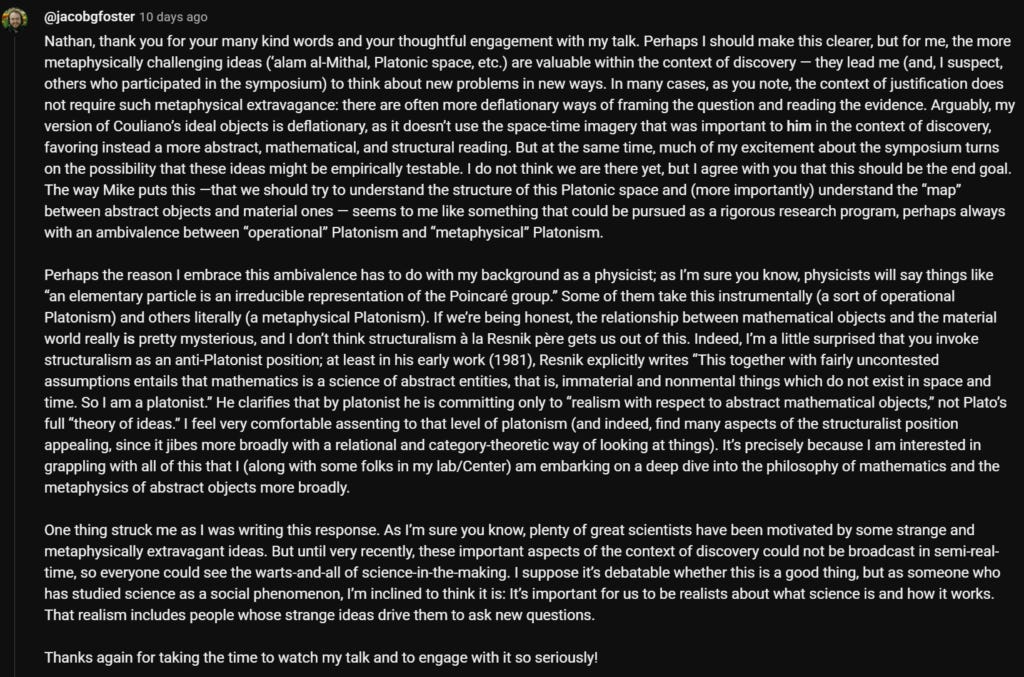
He wrote:
Nathan, thank you for your many kind words and your thoughtful engagement with my talk. Perhaps I should make this clearer, but for me, the more metaphysically challenging ideas (‘alam al-Mithal, Platonic space, etc.) are valuable within the context of discovery — they lead me (and, I suspect, others who participated in the symposium) to think about new problems in new ways. In many cases, as you note, the context of justification does not require such metaphysical extravagance: there are often more deflationary ways of framing the question and reading the evidence. Arguably, my version of Couliano’s ideal objects is deflationary, as it doesn’t use the space-time imagery that was important to him in the context of discovery, favoring instead a more abstract, mathematical, and structural reading.
Stop and notice what just happened. A co-director of the Diverse Intelligences Summer Institute, on the channel of the researcher whose symposium he presented at, just conceded that “the context of justification does not require such metaphysical extravagance.” He called his own version of Couliano “deflationary.” He used the word “extravagance” for the metaphysical claims the symposium was organized to advance.
He continued by invoking Resnik’s 1981 self-description as a “platonist,” claiming surprise that I treated structuralism as anti-Platonist:
Indeed, I’m a little surprised that you invoke structuralism as an anti-Platonist position; at least in his early work (1981), Resnik explicitly writes “This together with fairly uncontested assumptions entails that mathematics is a science of abstract entities, that is, immaterial and nonmental things which do not exist in space and time. So I am a platonist.” He clarifies that by platonist he is committing only to “realism with respect to abstract mathematical objects,” not Plato’s full “theory of ideas.” I feel very comfortable assenting to that level of platonism (and indeed, find many aspects of the structuralist position appealing, since it jibes more broadly with a relational and category-theoretic way of looking at things).
He also offered a defence I want to take seriously, because it is both genuine and structurally revealing:
One thing struck me as I was writing this response. As I’m sure you know, plenty of great scientists have been motivated by some strange and metaphysically extravagant ideas. But until very recently, these important aspects of the context of discovery could not be broadcast in semi-real-time, so everyone could see the warts-and-all of science-in-the-making. I suppose it’s debatable whether this is a good thing, but as someone who has studied science as a social phenomenon, I’m inclined to think it is: It’s important for us to be realists about what science is and how it works.
I responded in two parts, demonstrating from the elder Resnik’s own published work that his mature programme, particularly “A Naturalized Epistemology for a Platonist Mathematical Ontology” and Mathematics as a Science of Patterns (Oxford, 1997), systematically eliminates every feature of Levin’s Platonism that the word “platonist” was being used to defend.
Resnik’s own framing of his project could not be more explicit: “Any satisfactory epistemology should explain our knowledge of mathematical objects without endowing them or ourselves with occult properties or faculties.” I asked Foster directly: does “a Platonic space that is cagey and shy, that doesn’t like to be observed directly” qualify as avoiding occult properties? Does “calling down non-corporeal intelligences through appropriate configurations of matter” qualify as avoiding occult faculties? By the elder Resnik’s own standard, these are precisely the moves a naturalized Platonism must reject.
I showed that Resnik was collapsing the gap between the mathematical and the physical, not reinforcing it. Resnik’s own words: “from the point of view of today’s science, physical reality is most accurately described as an unchanging structure, whose local variations may be described in less sophisticated terms as bodies and causes, changes and happenings.” And: “In my version of Platonism, mathematical objects are positions in patterns, and mathematical knowledge is knowledge about patterns.” Positions in patterns. Not forms in a transcendent space. Not objects accessed through ingression. Relational positions whose identity is fixed by their structural role.
I pressed the questions Foster had not answered:
So when you say you’re “comfortable assenting to that level of platonism” and find “many aspects of the structuralist position appealing, since it jibes more broadly with a relational and category-theoretic way of looking at things,” I want to ask a genuine question: what exactly separates your position from mine? You’ve conceded that the context of justification doesn’t require metaphysical extravagance. You’ve described your own version of Couliano as deflationary. You find the structuralist, relational, category-theoretic framing appealing. The elder Resnik, whose authority you invoked, explicitly rejects mysterious epistemic access to abstract objects and builds a naturalized account based on pattern recognition and structural relations.
And I named the contradiction the shared label was concealing:
The word “platonist” is doing enormous work in making these positions look like points on a spectrum. They are not. Resnik’s platonism is an existence claim plus a naturalization program. Levin’s Platonism is an existence claim plus an inexplicable access mechanism (and corresponding interaction problem, unsolved since Aristotle, 2400 years running) that reintroduces everything the naturalization program was designed to eliminate. The elder Resnik spent four decades arguing that mathematical knowledge requires no break in the closure of the physical world. Levin’s 2022 paper explicitly claims to “break the closure of the physical world.” These are not ambiguities within a shared position. They are direct contradictions, papered over by a shared label.
Foster’s Second Response and Its Concessions
Foster replied again, prefacing with “I hope you’ll forgive me for being relatively brief; I’ve got too much on my plate to write the detailed response that your thoughtful reply deserves.” What followed was not brief. It was a carefully constructed series of concessions wrapped in diplomatic language whose full implications become visible only when read against the institutional context.
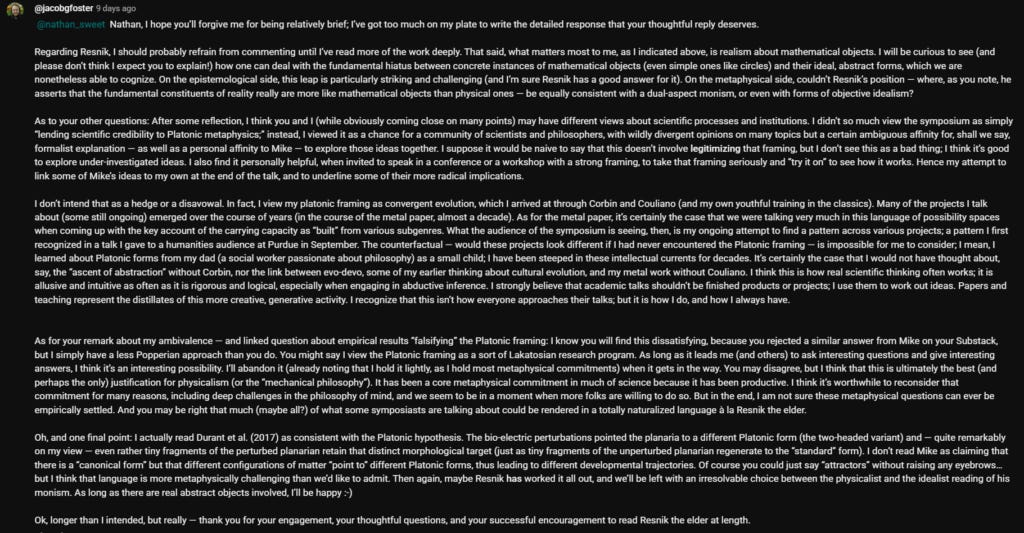
On Resnik:
Regarding Resnik, I should probably refrain from commenting until I’ve read more of the work deeply.
He acknowledged he had invoked an authority he hadn’t fully studied.
On the possibility of naturalizing the symposium’s content:
And you may be right that much (maybe all?) of what some symposiasts are talking about could be rendered in a totally naturalized language à la Resnik the elder.
That parenthetical “maybe all?” is extraordinary. A founding co-Director of the Diverse Intelligences Summer Institute, on Levin’s channel, just conceded that perhaps the entire Platonic apparatus is unnecessary.
On the symposium’s institutional function:
I didn’t so much view the symposium as simply “lending scientific credibility to Platonic metaphysics;” instead, I viewed it as a chance for a community of scientists and philosophers, with wildly divergent opinions on many topics but a certain ambiguous affinity for, shall we say, formalist explanation — as well as a personal affinity to Mike — to explore those ideas together. I suppose it would be naive to say that this doesn’t involve legitimizing that framing.
He acknowledged the symposium functions as legitimation while trying to reframe it as exploration.
On the counterfactual question, whether his work would look different without the Platonic framing:
The counterfactual — would these projects look different if I had never encountered the Platonic framing — is impossible for me to consider; I mean, I learned about Platonic forms from my dad (a social worker passionate about philosophy) as a small child; I have been steeped in these intellectual currents for decades.
He could not answer. The institutional capture literature predicts exactly this: when structural incentives have been internalized deeply enough, they feel like personal biography rather than institutional influence.
On his metaphysical commitments:
I hold it lightly, as I hold most metaphysical commitments.
And then came the Durant reinterpretation, which I believe is the single most structurally revealing moment in the entire exchange:
I actually read Durant et al. (2017) as consistent with the Platonic hypothesis. The bio-electric perturbations pointed the planaria to a different Platonic form (the two-headed variant) and — quite remarkably on my view — even rather tiny fragments of the perturbed planarian retain that distinct morphological target (just as tiny fragments of the unperturbed planarian regenerate to the “standard” form). I don’t read Mike as claiming that there is a “canonical form” but that different configurations of matter “point to” different Platonic forms, thus leading to different developmental trajectories. Of course you could just say “attractors” without raising any eyebrows… but I think that language is more metaphysically challenging than we’d like to admit.
I responded by making the logical structure of this move visible:
Sit with the logic. If convergence toward canonical morphology confirms Platonism, and permanent divergence to a novel morphology also confirms Platonism, what outcome of any kind counts against it? You’ve shown the framework absorbs all possible results. Convergence confirms it. Divergence confirms it. No result loses. Flew called this “death by a thousand qualifications.”
“I Simply Have a Less Popperian Approach Than You Do”
This sentence, from Foster’s second response, is the most structurally important thing he said in the entire exchange, and it requires careful dismantling because the move it performs is the single most common mechanism by which unfalsifiable frameworks evade accountability.
Foster’s full statement was:
As for your remark about my ambivalence — and linked question about empirical results “falsifying” the Platonic framing: I know you will find this dissatisfying, because you rejected a similar answer from Mike on your Substack, but I simply have a less Popperian approach than you do. You might say I view the Platonic framing as a sort of Lakatosian research program. As long as it leads me (and others) to ask interesting questions and give interesting answers, I think it’s an interesting possibility. I’ll abandon it (already noting that I hold it lightly, as I hold most metaphysical commitments) when it gets in the way.
Read that again. “I simply have a less Popperian approach than you do.” This frames our disagreement as a difference of methodological preference, like preferring qualitative over quantitative methods, or Bayesian over frequentist statistics. It is not. It is a framework that generates predictions disagreeing with a framework that does not, and framing that difference as a stylistic choice is how the substantive question gets neutralized before it can be answered.
The move is structurally identical to “falsifiability isn’t falsifiable,” which is the single most reliable signal that someone has not read the literature they are critiquing and would prefer you didn’t notice. The self-refutation objection treats falsificationism as a first-order empirical claim and asks whether it passes its own test. But falsificationism is a second-order methodology, evaluated by the progressive or degenerating character of the research programmes it generates. Applying the single-statement falsification test to the methodology is the epistemic equivalent of asking whether the rules of chess constitute a legal chess move. You have not found a contradiction. You have demonstrated you do not know what kind of thing you are talking about. And the move is never made innocently. It is made to neutralize epistemic standards before the real work begins, which is sneaking empirical claims past the audience while appearing to transcend the empirical altogether. Flew (1950) named this: death by a thousand qualifications, where the claim retreats from every falsifying condition until nothing remains to test, and then the retreat gets called depth.
For a full treatment of why this move fails and how six independent lines of defence rescue falsificationism from the self-refutation objection, see my response to philosopher Matt Segall’s deployment of the same defence.
And the move is never made innocently. It functions to neutralize epistemic standards before the real work begins, which is defending empirical claims under metaphysical cover. Here is the playbook, and Foster’s exchange follows it precisely:
First, reframe your opponent’s standards as their limitation. Foster suggested I was “trapped” in a Popperian framework that he has transcended through broader reading. But falsificationism is not a personal commitment. It is a methodology whose track record can be evaluated against alternatives. Popper’s criterion has been tested across centuries of scientific practice: fields that adopt falsification converge on more reliable knowledge, programmes that avoid it degenerate, and the entire arc from alchemy to chemistry to phlogiston’s collapse confirms the predictions falsificationism makes about how inquiry behaves. Tetlock (2005, 2015), across tens of thousands of controlled predictions, found that forecasters maintaining explicit loss conditions dramatically outperformed prior-protectors. The Open Science Collaboration (2015) confirmed that replication rates track methodological rigor across fields. Evidence-based medicine produced a measurable inflection in life expectancy curves. These are not opinions about method. They are outcome data.
Second, invoke Lakatos as a shield against falsification demands. Foster explicitly did this: “You might say I view the Platonic framing as a sort of Lakatosian research program.” But Lakatos never replaced falsification with fecundity. He refined Popper; he did not soften the criterion. Lakatos’s own words: “In a progressive research programme, theory leads to the discovery of hitherto unknown novel facts. In degenerating programmes, however, theories are fabricated only in order to accommodate known facts” (MSRP, 1978, pp. 3-5). And: “Our empirical criterion for a series of theories is that it should produce new facts. The idea of growth and the concept of empirical character are soldered into one” (Criticism and the Growth of Knowledge, 1970, p. 119). Soldered. Not “balanced.” Not “weighed against other considerations.” Soldered into one. Growth without novel empirical predictions is degeneration, full stop.
Lakatos classified Marxism as degenerating despite its enormous scholarly productivity, because its “auxiliary hypotheses were all cooked up after the event to protect Marxian theory from the facts.” He also wrote: “Intellectual honesty consists in stating the precise conditions under which one will give up one’s belief” (MSRP, p. 1). That question was asked three times across our exchange. It remains unanswered. By Lakatos’s own criteria, the Platonic programme exhibits every marker of degeneration: no novel facts predicted in advance, post hoc accommodation of results a rival programme predicted, and inability to specify loss conditions. If you invoke Lakatos, his methodology applies to your framework too.
Third, treat the absence of crisis as evidence of health. Foster’s “I’ll abandon it when it gets in the way” sounds like intellectual flexibility. It is the precise move Lakatos identified as the signature of degeneration: a framework that never gets in the way because it has been designed to absorb every result. The constraint-based account gets in the way all the time, because it makes predictions that can fail. That is not a deficiency. It is what makes it science.
Mayo’s severe testing criterion (2018) makes this sharper still: a claim passes severe testing when the data would very probably not fit the claim if the claim were false. Falsificationism has been subjected to conditions under which it could have failed: fields adopting falsification criteria could have converged no faster than fields that didn’t; forecasters using falsification discipline could have performed no better than prior-protectors. Both tests were run. Falsificationism passed. The “I have a different approach” defence has never been subjected to any test at all, because subjecting it to a test is precisely what the approach is designed to avoid.
There is a further prediction falsificationism makes that directly bears on the present case: unfalsifiable frameworks will fragment into competing factions rather than converge, because without external constraint, each faction accommodates all evidence through ad hoc modification. Check the historical record. Neoplatonic emanationism, the tradition Levin’s Platonic Space Symposium explicitly invokes, has produced two thousand years of faction proliferation with zero convergence on testable claims: Plotinus, Porphyry, Iamblichus, Proclus, and seventeen centuries of successors disagreeing on virtually every structural detail with no principled mechanism for resolution, because the framework was designed to escape the only tools that could settle it. Psychoanalytic schools multiplied and never converged. Alchemical traditions fragmented. Fragmentation is not depth or richness. It is the predicted signature of a framework with no external constraint forcing convergence, and it is already visible in the “diverse intelligences” ecosystem, where “cognition” means something different in every paper depending on which collaborator is writing.
Foster’s framing of our disagreement as methodological preference also conceals a deeper self-refutation. If his “less Popperian approach” is itself a claim about what constitutes good scientific practice, what would show it wrong? If no outcome would, the approach is unfalsifiable by its own admission, and using it to defend an unfalsifiable framework is circular. If some outcome would, then he has loss conditions after all, and we are back to the question he has avoided three times: what are they?
The Physicalism That Nobody Holds
Foster also wrote:
You may disagree, but I think that this is ultimately the best (and perhaps the only) justification for physicalism (or the “mechanical philosophy”). It has been a core metaphysical commitment in much of science because it has been productive. I think it’s worthwhile to reconsider that commitment for many reasons, including deep challenges in the philosophy of mind.
And separately:
I think that [attractor] language is more metaphysically challenging than we’d like to admit.
This framing requires the position I am advancing to be naive physicalism, the billiard-ball, matter-in-motion picture that treats mathematics as mere description and consciousness as an embarrassment. Against that straw opponent, Platonism looks sophisticated and necessary. But I have never defended that position, and the alternative I have been articulating throughout this exchange is not physicalism at all.
The position is structural realism, and the elder Resnik whom Foster cited is its proof. When Resnik argues that physical reality is “most accurately described as an unchanging structure” and quantum particles “seem more like mathematical objects than everyday, commonsense bodies,” he is not being a naive physicalist. He is dissolving the abstract/concrete distinction that makes the math-world relationship look “mysterious” in the first place. Structural realism holds that relations are primary, that mathematical structure is immanent in physical process, and that what we call “physical” and what we call “mathematical” are two descriptions of the same relational architecture, not two different kinds of stuff requiring a bridge between them.
An attractor, in this framework, is not metaphysically mysterious. It is a mathematical description of a dynamical system’s long-term behavior under current constraints. It is falsifiable: change the constraints and the attractor changes, which is exactly what Durant showed. It carries no interaction problem because it does not posit a non-physical realm that must somehow causally influence the physical. The “metaphysical challenge” Foster senses in attractor language evaporates once you stop assuming attractors must be housed somewhere separate from the dynamics they describe. That assumption is residual substance ontology, and structural realism was specifically built to eliminate it.
Here is the part I most wanted Foster to notice, and the part that connects directly to the institutional capture analysis: his critique of physicalism lands only against a position nobody in our conversation holds. And it lands on his own framework with greater force.
Platonism is a substance ontology. It posits physical stuff and a separate Platonic realm, then cannot explain how they interact. Every “deep challenge” Foster raises against naive physicalism applies to Platonism with an extra ontological commitment bolted on. Naive physicalism has one substance and struggles with the mind-body problem. Platonism has two substances and struggles with the interaction problem, which is structurally identical but has been unanswered since Aristotle objected to Plato 2,400 years ago. You haven’t escaped the problem; you’ve doubled it. The “mystery” of the math-world relationship that Foster points to is generated by the Platonic framework, which insists they are separate domains, and dissolved by structural realism, which shows they never were. Platonism creates the mystery it claims to address. Meanwhile, organizational closure (Montévil-Mossio 2015), enacted cognition (Varela, Thompson, Rosch 1991), and active inference (Friston 2010) address the “deep challenges in philosophy of mind” within structural realism, requiring no transcendent forms and generating no interaction problem.
There is a deeper irony here, and it applies to Levin’s framework even more directly than to Foster’s. Levin’s Platonism, which presents itself as transcending reductive physicalism, actually depends on reductive physicalism as its necessary foil. The Platonic morphospace only becomes explanatorily necessary if you first accept the 17th-century Cartesian premise that matter is inert, mechanical, and intrinsically devoid of organizational capacity, because it is precisely that emptied-out matter that requires atemporal forms to explain why organisms develop the way they do. Constraint-based accounts, Montévil and Mossio’s organizational closure, Deacon’s teleodynamics, Prigogine’s dissipative structures, never accepted that premise in the first place, which is why they require no Platonic supplement: matter defined as inherently relational, processual, and self-organizing generates morphogenetic directionality without importing it from a transcendent realm. Levin’s framework is not escaping reductive physicalism. It is parasitic on it, because the moment you replace Cartesian matter with relational constraint dynamics, the explanatory gap the morphospace was designed to fill simply does not exist. The framework needs the disease it claims to cure.
Any substance dualist, panpsychist, or Platonist framework that claims causal efficacy, that claims non-physical forms make real differences in real biological systems, owes an account of the energy dissipation involved. This is the Landauer bound, experimentally confirmed by Bérut et al. (2012): maintaining any distinction costs a minimum of kT ln(2) per bit erased. If Platonic forms causally interact with physical systems, they are dissipating energy, and Levin owes an account of that dissipation. If they make no causal difference, he has defined them into explanatory irrelevance. There is no third option, however many qualifications are layered on top.
The Final Comment and the Escalation Timeline
After Foster went quiet, I posted a final formalization of the Lakatosian diagnosis, preceded by Popper’s foundational statement:
“A theory which is not refutable by any conceivable event is nonscientific. Irrefutability is not a virtue of a theory (as people often think) but a vice.” — Karl Popper, Conjectures and Refutations
And the note that Lakatos did not soften this demand but raised it:
Lakatos didn’t soften this demand; he raised it, requiring not merely that a theory could be refuted in principle but that it actively predict facts nobody had thought to look for, making “I’ll abandon it when it gets in the way” even less adequate than Popper would have found it.
I then laid out the full three-criterion diagnosis and the fecundity alibi’s historical parallels, and identified a deeper irony worth making explicit: that Levin’s Platonism is parasitic on the very reductive physicalism it claims to transcend. These arguments appear in Sections VII and XI of this article.
The escalation timeline of Levin’s metaphysical claims makes the Lakatosian trajectory visible in publication chronology:
In 2022, the TAME paper used computational and cybernetic language without Platonic forms. By 2024, the Thoughtforms blog introduced explicit Platonic terminology. In 2025, “Ingressing Minds” proposed non-physical causation, and by late 2025, Platonic Space was described as “cagey and shy” and resistant to direct observation. By early 2026, “Mind Everywhere,” funded by the Templeton Foundation, made the most expansive claims yet. This is not the trajectory of a framework approaching testability. It is the trajectory of a framework escalating its commitments as it retreats from the constraints that would test them.
What Foster Avoided, and Why
Foster never disputed the Lakatosian analysis. He never challenged a single factual claim across thousands of words. He never defended Levin’s specific metaphysical claims. He never addressed the Discovery Institute citation pattern, raised twice. He never answered the falsification question, asked three times.
And then he went quiet.
I want to be careful here, because I believe what happened next is more revealing than the exchange itself. After nine days of public discourse, Foster stopped responding publicly. But his engagement did not stop. He appeared on my mailing list, and his click-through rate on every piece of content I subsequently published was one hundred percent. Nine days and counting past our exchange, every article, every update, opened and read.
That is not the behavior of someone who disagrees. It is the behavior of someone who found something they were looking for but cannot say so in the institutional context where the exchange occurred.
The most generous reading, and I believe probably the most accurate: Foster is a genuinely brilliant person who found himself in a conversation where someone applied his own professional tools to his own institutional position with a rigor he could not dismiss and a conclusion he could not publicly accept. His response was to concede everything concedable, avoid contesting anything he knew was correct, point me toward sources that would strengthen my position, praise the engagement with warmth exceeding professional courtesy, and then go quiet publicly while maintaining complete private engagement with my subsequent work.
I get it. Imagine being in that position: your professional identity, your institutional role, your funding pipeline, your training programme, your editorial relationships, your network of collaborators, all organized around the proposition that “Diverse Intelligences” is a legitimate research framework. If you concede that the Platonic component is a degenerating sub-programme parasitic on progressive empirical work, you are not just revising a philosophical view. You are undermining the institutional rationale for your own centre, your own summer institute, your own TWCF grants, and the career trajectories of every early-career researcher you have trained through DISI since 2018. I would probably feel paralyzed by that too. And I think that paralysis, the gap between private intellectual conviction and public institutional constraint, is what institutional capture looks like from the inside.
The institutional capture literature identifies this dynamic precisely: when structural incentives are internalized deeply enough, they feel like personal conviction. The funding did not make Foster a Platonist. Foster’s pre-existing Platonic sympathies, cultivated since childhood through his father’s passion for philosophy, made him the ideal person to run the institutional infrastructure, which then reinforced and rewarded those sympathies until they felt even more authentically his own. The capture is not coercion. It is resonance selection. The system selects for people whose genuine intellectual inclinations align with the funding framework, then provides them with resources, status, and community that make those inclinations feel validated rather than structurally incentivized.
V. The Co-Author’s Dilemma: David Resnik’s Father’s Structuralism That Couldn’t Speak Its Name
If Foster’s exchange demonstrates how institutional capture operates on someone adjacent to the research programme, the correspondence with David Resnik demonstrates how it operates on someone inside it. Resnik is Levin’s co-author on the “Mind Everywhere” papers in Biological Theory, an NIH bioethicist, and the son of Michael D. Resnik, the philosopher whose mathematical structuralism I have been arguing provides the naturalistic alternative Levin’s Platonism renders unnecessary.
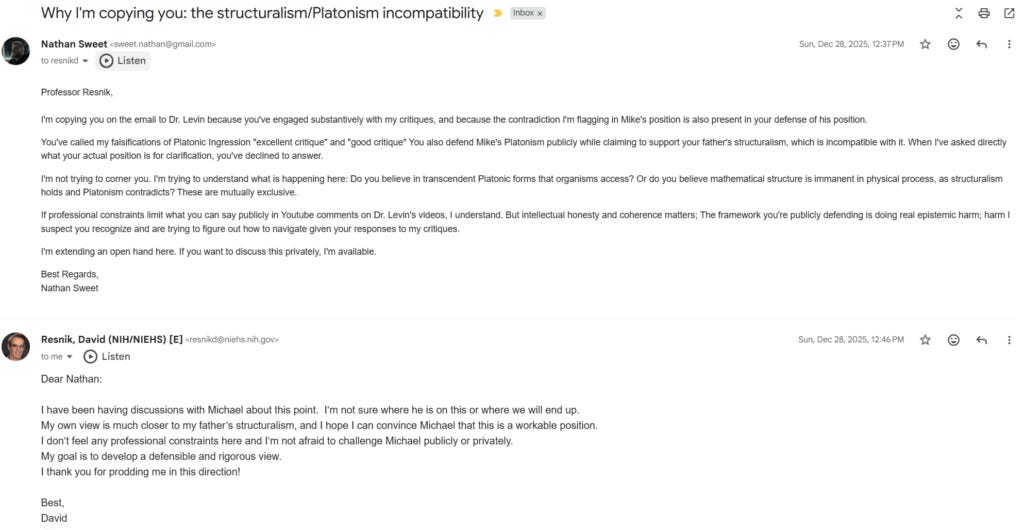
On December 28, 2025, I emailed Resnik directly, copying Levin, to flag the contradiction between his public defence of Levin’s Platonism and his private acknowledgment that his father’s structuralism is incompatible with it. His response arrived within fourteen minutes:
My own view is much closer to my father’s structuralism, and I hope I can convince Michael that this is a workable position. I don’t feel any professional constraints here and I’m not afraid to challenge Michael publicly or privately. My goal is to develop a defensible and rigorous view. I thank you for prodding me in this direction!
Two days later, on December 30, he wrote:
I have pressed Levin on this issue and hope to get him to see the merits of a structuralist approach and to drop talk of a separate Platonic realm or “ingression.”

And:
Structuralism is the position I favor and I hope to convince Michael of.
Read those sentences again. Levin’s co-author on the paper the Discovery Institute would celebrate ten weeks later as “The Levin Teleology Revolution” privately favours the framework I have been arguing should replace Levin’s Platonism, is actively trying to convince Levin to drop the Platonic vocabulary, and thanked an outside critic for “prodding me in this direction.” The published paper reflects none of this movement. “Mind Everywhere: Part Two” appeared in Biological Theory in early 2026 with its Platonic commitments intact.
What happened between private concession and public publication is a case study in the behavioral signatures the institutional capture literature predicts.
The Pattern of Deflection
Over a two-day email exchange comprising over a dozen messages to me, Resnik exhibited a consistent pattern: substantive engagement with positions I did not hold, and silence on the positions I did.
Three times he directed me to the preprint of the goal-directedness paper as a response to my critiques. Three times I pointed out that the preprint is naturalistic, aligns with my position, and does not address a single point of my critique, which concerned Levin’s public Platonic additions (“ingression,” “thin clients,” “free lunches,” “physicalism is not viable”) that appear in podcasts, YouTube videos, and symposia reaching millions, not in their peer-reviewed work.
When he did engage substantively, his quotes defended against reductive materialism, a position I had explicitly and repeatedly rejected. I had stated in plain language that thermodynamic monism rejects both materialism and reductionism because both presuppose substance ontology. Resnik’s response was to send quotes from the preprint arguing the framework is “compatible with scientific materialism” and does not assume “dualism, vitalism, or any type of exotic metaphysics.” These are excellent defences against a position I do not hold. They do not address the structuralist critique I do hold, which also rejects eliminative materialism for the same reasons. Defending against the wrong opponent while the actual critique sits unacknowledged is one of the most common mechanisms by which unfalsifiable frameworks evade scrutiny.
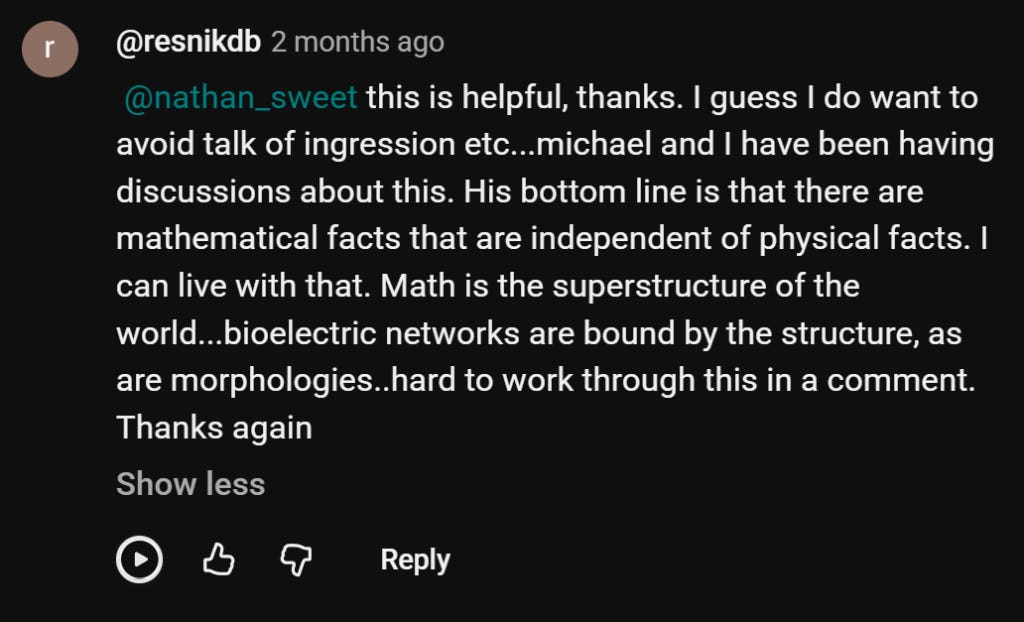
When I asked directly how the claim that “mathematical facts are independent of physical facts” is compatible with his father’s structuralism, Resnik replied by invoking Max Tegmark’s Mathematical Universe Hypothesis and Stephen Wolfram’s Ruliad. Both frameworks have been critiqued in the peer-reviewed literature as unfalsifiable in principle. Natal (2024, arXiv:2411.12562v3) identifies the fatal flaw: both conflate mathematical potential with physical actuality, and if all mathematical structures exist “eternally,” they explain nothing about why this universe exists with these laws. The framework becomes unfalsifiable because it predicts everything and therefore distinguishes nothing. Rickles, Elshatlawy, and Arsiwalla (2023, arXiv:2308.16068v2) identify the “realization problem”: if abstract structures generate reality, what does the generating? The generator must itself be mathematically describable, creating infinite regress. Thermodynamic monism dissolves this: there is no external generator; constraint satisfaction is immanent in physical dynamics, requiring no ontological bridge. Sabine Hossenfelder, a respected mainstream physicist, dismisses Tegmark as unfalsifiable, superfluous by Occam’s razor, and “not even wrong,” noting that claiming the universe “is” mathematics rather than “is described by” mathematics adds nothing explanatory, since scientists never need this assumption to do physics. Woit and Smolin both note that claiming “all mathematical structures exist” is vacuous; it predicts too much and too little. Appealing to unfalsifiable frameworks to defend an unfalsifiable position does not resolve the unfalsifiability. It compounds it. I have documented the systematic failure of these frameworks, alongside Levin’s morphospace, Penrose-Hameroff’s Orch-OR, and others, in a comprehensive constraint-based audit : The Metaphysics Audit.
More revealingly, Resnik wrote in the same email: “My view is that the universe has a mathematical structure that underlies physics. Mathematics defines a space of possible events, processes, and interactions in the physical world; it is immanent in the world, not separate from it.” He then concluded: “In this way, there can be mathematical facts that are independent of physical facts.”
But immanence and independence are mutually exclusive. If mathematics is immanent in the world, it is not independent of the physical. If it is independent of the physical, it is not immanent but transcendent, and you need an interaction mechanism to explain how it causally influences physical systems.
The Internet Encyclopedia of Philosophy states this directly:
“An impenetrable metaphysical gap between the mathematical and spatio-temporal realms of the type that proponents of the epistemological challenge insist exists if platonism is true would exclude the possibility of causal interaction between human beings, who are inhabitants of the spatio-temporal realm, and mathematical entities, which are inhabitants of the mathematical realm.”
The Stanford Encyclopedia of Philosophy’s entry on naturalism and mathematics makes the implication explicit:
“Given that mathematical and modal facts are abstract in the sense of lying outside space and time, it follows that there is no possibility of identifying them with the kind of natural facts that have physical effects. If naturalist realism about mathematics is thus ruled out, the remaining options are irrealism and non-naturalist realism.” Independence, as Resnik claimed, equals separation equals transcendence. You cannot claim both immanence and independence without reproducing the interaction problem his father’s structuralism was designed to dissolve. The contradiction within a single paragraph mirrors the motte-bailey structure I documented in Levin’s public presentations: naturalistic language when challenged, Platonic commitments when unchallenged, and a verbal formula designed to make them look continuous when they are not.
What Remained Unaddressed
Across the full exchange, Resnik never addressed:
How Durant et al. (2017) does not falsify Platonic convergence predictions, despite repeated raising.
What mechanism enables “ingression” from a non-physical realm, the interaction problem Aristotle identified 2,400 years ago.
What empirical result would falsify Platonic morphospace.
The Discovery Institute’s citation of their work as supporting creationism.
The Landauer bound’s implications for any framework claiming non-physical causal influence on physical systems.
Instead, when I pressed on professional responsibility, citing NIH scientific integrity policy, ICMJE authorship accountability standards, and the peer-reviewed literature on co-author obligations, Resnik drew a line:
I do not consider it to be my business to correct what Michael Levin may have said about Platonic space on videos, podcasts, blogs, etc. However, I will definitely take responsibility for works that I am an author on to make sure that they are the best they can be in terms of arguments, logic, and data.
This is a coherent position for a co-author of technical papers. It is not a coherent position for an NIH bioethicist whose co-authored work provides the credibility cover that makes Levin’s public Platonic additions function. The peer-reviewed naturalistic work is the motte. Levin’s podcast Platonism is the bailey. The motte-and-bailey structure functions precisely because the person who wrote the motte declines to address the bailey. And the Discovery Institute does not distinguish between the two when citing “Levin and Resnik” as supporting teleological arguments “harking back to Aristotle and Plato.”
Two Resniks, One Capture
The deepest structural irony in this correspondence is genealogical. Michael D. Resnik spent four decades building a framework, mathematical structuralism, that naturalizes mathematical epistemology, dissolves the abstract/concrete distinction, identifies mathematical objects as positions in relational structures rather than inhabitants of a transcendent realm, and explains mathematical knowledge through ordinary cognitive processes without “endowing them or ourselves with occult properties or faculties.” His son David Resnik privately favours this framework, is actively trying to convince his co-author to adopt it, and thanked an outside critic for reinforcing that effort.
And yet the published paper that bears David Resnik’s name as co-author advances the Platonic vocabulary his father’s life’s work was designed to eliminate. The Discovery Institute celebrates that paper as the arrival of “the Levin Teleology Revolution.” The elder Resnik’s structuralism predicted the empirical findings, path-dependent morphology, attractor-state stability, constraint-determined form, decades before Levin’s laboratory confirmed them. The published credit flows to a Platonic framework the same data falsifies.
I do not think David Resnik intended any of this. I think he found himself in a collaborative relationship with a charismatic and productive senior researcher, discovered over time that the interpretive framework was drifting away from the positions he actually holds, tried to nudge it back, and encountered the structural reality that co-authorship within an institutional ecosystem limits how far you can push before the collaboration itself becomes untenable. I would probably navigate those constraints similarly if I were in his position, and I suspect most honest academics would too. The system does not need anyone to act in bad faith. It needs only that the costs of public correction exceed the costs of private discomfort, which they almost always do in collaborative science.
David Resnik told me, in writing, that structuralism is the position he favours. He told me he is pressing Levin to drop the Platonic vocabulary. He told me he hopes to convince Levin of structuralism’s merits. These are not the words of someone who endorses the framework the Discovery Institute is celebrating. They are the words of someone caught between private conviction and institutional architecture, managing the gap as best he can while the downstream consequences compound.
The elder Resnik’s framework deserves better than to have its predictive successes credited to the metaphysics it was built to replace. And David Resnik deserves recognition for the honesty he expressed in private correspondence, even as the institutional structure prevented that honesty from reaching the published page.
VI. The Editorial and Citation Structure
Levin is co-editor-in-chief of Bioelectricity and founding associate editor of Collective Intelligence. Both journals’ scope is defined by the theoretical framework they are meant to evaluate. Being editor-in-chief of a journal named after your research programme’s central concept is a textbook mechanism for editorial gatekeeping, where the framing of acceptable contributions is pre-shaped by the editorial vision before a manuscript is ever submitted.
The citation network is tightly coupled. The HADES paper (Hartl, Zhang, Hazan, and Levin) builds directly on Zhang, Hartl, Hazan, and Levin (March 07 2026, “Diffusion Models Are Evolutionary Algorithms”). Same four authors, rearranged. The HADES paper’s Section 4.1 makes the ontological claim that a diffusion model “literally represents a lineage’s evolving genome,” while Hartl and Levin (2025, Trends in Genetics) simultaneously acknowledges that the same analogy faces “significant challenges.” The same laboratory, overlapping author sets, publishing contradictory epistemic stances across different journals in the same year, with each paper citing the other.
Three hundred and fifty publications create massive citation mass, heavily self-referencing, which in turn creates the appearance of a large, active research community validating the framework when much of the citation weight is internal to the network. Chris Fields and Levin have co-authored extensively across active inference, tensor networks, quantum formulations, and “control flow in active inference systems.” Fields provides the mathematical formalism for many of Levin’s most speculative claims. The collaboration creates the appearance of rigorous mathematical grounding for claims that are fundamentally philosophical.
None of this is unusual in science. Productive labs cite their own work. Collaborators build on each other’s publications. The question is not whether the pattern exists but whether it is accompanied by the external coupling, the engagement with competing frameworks and disconfirming evidence, that Lakatos requires for a progressive programme. On that criterion, the pattern fails. The constraint-based alternatives, Montévil and Mossio’s organizational closure, Deacon’s teleodynamics, Varela and Thompson’s enactivism, Ladyman and Ross’s structural realism, are systematically absent from the citation network. The one paper that comes closest to providing an external challenge, Milinkovic and Aru’s (2026) alternative framework, never names Levin and is not cited by Levin’s group.
VII. Denis Noble: When Capture Consumes Its Most Important Victim
This section is the hardest to write, because it requires holding in mind simultaneously that Denis Noble made a genuinely revolutionary discovery, that he overreached in ways that deserve criticism, that the institutional ecosystem consumed his legitimate insights, and that the resulting destruction of his reputation makes the constraint-based alternative harder for everyone.
Noble is a Fellow of the Royal Society, emeritus professor at Oxford, and pioneer of systems biology. In 1960, he developed the first mathematical model of cardiac cells, demonstrating that heart rhythm is an emergent property of feedback loops rather than a single oscillator. His formal proof that “downward causation” operates as boundary conditions on differential equations constraining lower-level dynamics is foundational systems biology. This is organizational closure demonstrated empirically in cardiac tissue decades before Montévil and Mossio formalized it in 2015.
Noble’s cardiac modeling shows exactly what “downward causation” means when done rigorously: the cell-level membrane voltage constrains protein channel behavior, protein channels constrain ion flows, ion flows constrain voltage, and the closure of that constraint loop generates the heartbeat as an emergent property that exists at no single level. Remove the downward causation by voltage-clamping the cell, and the rhythm stops. This is not metaphor. It is mathematics, and the mathematics requires no Platonic realm, no transcendent forms, no “purposive agency.” It requires boundary conditions on differential equations, which is precisely the constraint-based formalism I argue should replace Levin’s Platonic morphospace.
Noble himself stated it with admirable precision: “In setting boundaries, downward causation can be viewed more like a context, setting constraints, purpose and goals.”
And there it is. The word “purpose.” The word “goals.” The moment where Noble’s legitimate constraint-based insight begins its journey toward capture.
Scale 1: Noble’s Insight Gets Captured by His Own Overreach
Noble discovers something real: biological systems exhibit multi-scale constraint dynamics where higher-level boundary conditions constrain lower-level processes, and this constraint closure generates emergent properties. His mathematics does not require Lamarck. His boundary conditions on differential equations are physical constraints, not inherited acquired characteristics. But Noble, instead of connecting this insight to organizational closure theory, to Deacon’s teleodynamics, or to structural realism, reaches for Lamarck and “purposive agency.” The vocabulary of “purpose” and “agency” feels more exciting than “constraint closure.” It also maps onto philosophical commitments Noble cultivated long before any Templeton money arrived.
His “Third Way of Evolution” project, which co-hosts conferences and maintains a website of scholars questioning aspects of the Modern Synthesis, has itself acknowledged the co-optation problem. The TWE website states explicitly: “It has come to our attention that THE THIRD WAY web site is wrongly being referenced by proponents of Intelligent Design and creationist ideas as support for their arguments.”
Noble sees the co-optation. He names it. And yet the vocabulary that enables it persists.
Scale 2: Levin’s Ecosystem Absorbs Noble’s Credibility
Levin cites Noble as authority for “no privileged level of causation” and “downward causation.” On Sean Carroll’s podcast, Levin said: “People like Dennis Noble have been saying this much better than I, that you can’t simply pick a level because you like it, you have to pick the best level.” On the Templeton Ideas podcast, Levin made the same move: “Dennis Noble has written quite well, against that view” of gene-centrism.
Noble’s rigorous constraint-based cardiac work becomes a credibility input for Levin’s cognitive vocabulary, which then escalates: from “cells process information” to “cells know things” to “organisms navigate Platonic morphospace” to “minds ingress from a non-physical realm.” Noble himself never makes the Platonic claims. But by sharing platforms with Levin, by being cited as Levin’s authority on podcasts reaching millions, Noble’s constraint-based insights become load-bearing elements in an institutional structure that redirects them toward unfalsifiable metaphysics.
In January 2026, Noble’s “Third Way of Evolution” project co-hosted “Biological Relativity: Evolution for the 21st Century” at Balliol College, Oxford, with speakers including Denis Noble, James Shapiro, and Michael Levin. Noble’s conference. Levin’s vocabulary. The institutional convergence is documented.
Scale 3: The Skeptic Immune Response Destroys the Baby with the Bathwater
In May 2025, Professor Dave Farina, a science communicator with 4.22 million subscribers, published a caustic attack peice “Denis Noble is a Clown.” The video has 368,183 views as of this writing.
Farina gets things right: Noble publishes his evolutionary claims outside evolution-specific journals. The journal Noble edited published indefensible papers, including on octopus panspermia. Noble mischaracterizes the Central Dogma. “Directed mutation” in Noble’s strong sense lacks evidence. The Templeton funding connection is a legitimate concern.
Farina gets things catastrophically wrong: he treats Noble as a monolithic crank. He opens with “clown,” frames Noble’s entire post-retirement career as “Nobelitis,” and never once engages with the cardiac modeling work. He mentions Noble “developed the first mathematical model of cardiac cells in 1960” and then immediately pivots to dismissal. The framing makes Noble’s actual scientific contribution a brief credential to be noted and then ignored, rather than the key to understanding what he gets right and where he goes wrong. Noble is anything but a clown, and his work deserves infinitely more respect than his funding sources will allow it to earn.
Farina also arrives at the right conclusion by the wrong method. His observation that “agency-based theories are vacuous because they make the exact same predictions as neo-Darwinian ones” is precisely the Lakatosian degeneration argument. But he frames it as “Noble is stupid” rather than as a systematic diagnostic of what happens when unfalsifiable metaphysical layers ride progressive empirical programmes. He has the analytical tool and wields it as a club rather than a scalpel. Applying the same tools to his own critique, we can identify dozens of fallacies employed in Dave’s critique of Dr. Noble.
The deepest structural failure is that Farina never asks why Noble’s legitimate insights ended up in the Templeton/Levin ecosystem instead of in the constraint-based framework where they belong. The answer is institutional capture. Templeton funds “purpose” and “agency” research. The constraint-based alternative, organizational closure and structural realism, does not need purpose or agency vocabulary, so it does not get Templeton funding. Noble’s cardiac work could have been connected to Montévil and Mossio, to Deacon’s teleodynamics, to Kauffman’s constraint closure. Instead it got connected to Lamarck, to “purposive agency,” to the Third Way, because that is where the institutional incentives pointed.
Scale 4: The Destruction Makes the Alternative Harder to Advance
Because Farina’s caustic video, which is the #1 search result on youtube for the terms Denis Noble, in which Dave is denigrating Dr. Noble’s character has 368,000 views and positions Noble as a “clown,” anyone who now cites Noble’s legitimate multi-scale constraint dynamics work risks being associated with crankery. The very insights that would provide Levin’s empirical work with a rigorous, falsifiable theoretical home, organizational closure, constraint dynamics, boundary conditions as downward causation, become tainted by association with a figure the skeptic community has declared a crank. This makes the institutional capture more durable: the constraint-based alternative is harder to advance because the person who demonstrated it most clearly in cardiac tissue has been publicly destroyed for his separate, genuinely problematic evolutionary claims.
Noble deserves better than Levin’s ecosystem, and he deserves better than Farina’s video. What he deserves is what the constraint-based framework provides: a rigorous, falsifiable home for his insights about multi-scale constraint dynamics, separated from the Lamarckian overreach, the Templeton “purpose” vocabulary, and the Discovery Institute co-optation that have collectively buried the most important thing he ever demonstrated. The same pattern of naturalistic work being absorbed into the Platonic ecosystem while quietly replacing its core claims is documented across multiple symposium presentations, including Pavel Chvykov’s thermodynamic attractor theory and Gordana Dodig-Crnkovic’s cognitive Platonism, which David Resnik himself identified as “refangled Kantianism” rather than Platonism. (Youtube Link)

VIII. The Falsification That Already Happened
The empirical case against Levin’s Platonic morphospace does not require philosophical argument alone. It requires one paper: Durant et al. (2017), “Long-Term, Stochastic Editing of Regenerative Anatomy via Targeting Endogenous Bioelectric Gradients,” published in the Biophysical Journal, from Levin’s own laboratory.
Durant and colleagues, including Levin as senior author, demonstrated that a brief 48-hour disruption of gap junction connectivity permanently rewrites a planarian’s body plan. The two-headed phenotype is, “in the absence of further treatments, permanent: both heads can be removed, the middle fragment can be allowed to regenerate, and the heads removed again multiple times, over months until the worms are too small to cut, in plain water long after the original drug is gone.”
The paper’s own conclusion: “Thus, species-specific axial pattern can be overridden by briefly changing the connectivity of a physiological network.”
The phenotype is stochastic: “discrete outcomes occur in predictable ratios within a treated population, but individual animals (though clonal and living in the same environment) regenerate toward distinct outcomes despite identical experimental perturbation.” Adjacent pieces from the same worm make independent stochastic decisions about morphology.
This is, as the authors note, “the first demonstration in a metazoan organism of significant changes to the body plan that are stable, stochastic, and induced by a brief and purely physiological perturbation.”
If Platonic forms existed as pre-existing ideals that organisms “access,” these two-headed worms should gradually converge back toward the one-headed canonical form over multiple regeneration cycles. The form is the attractor; the perturbation is noise. Instead, they maintain the altered configuration permanently. There is no external ideal the organism is trying to reach. The “goal” is thermodynamic stability in whatever basin the system occupies.
When I raised this with Levin directly, his response was: “Again, my view is not that standard animals are the full extent of Platonic patterns, so 2-headed planaria are not a problem. But even if we did have only convergence toward pre-existing Platonic forms, how do you know the 2-headed form is not a manifestation of a pre-existing pattern? We haven’t mapped out the space, so it’s way too early to say anything like that.”
When I raised it with Foster, his response was structurally identical: “The bio-electric perturbations pointed the planaria to a different Platonic form.”
Both responses demonstrate the same logical structure. If an organism converging toward its canonical morphology confirms Platonism, and an organism diverging permanently to a novel morphology also confirms Platonism because the system was merely “pointed to a different form,” then no morphological outcome of any kind counts against the hypothesis. Any observed morphology can always be retroactively declared a member of an uncharted Platonic space. The empirical findings no longer constrain the theory; instead, the theory expands to accommodate every possible outcome.
The constraint-based account, by contrast, predicted Durant’s results in advance: disrupt bioelectric constraints, shift the attractor basin, new morphology persists as long as the new constraint regime holds. Each prediction can fail. A framework that accommodates every conceivable outcome has zero empirical content.
Lakatos’s definition of a degenerating research programme could have been written as a diagnostic of this exchange:
Criterion (a): no novel verified predictions beyond what the mechanistic bioelectric account generates. Every experimental success, limb regeneration, planarian axis reversal, tumor suppression, is fully predicted by constraint dynamics without any reference to atemporal forms.
Criterion (b): oscillation between “useful metaphor” and genuine ontological commitment depending on whether falsification pressure is being applied. Under challenge, Platonic morphospace retreats to mathematical modeling tool. When making positive claims about what organisms do, it returns as genuine ontological commitment.
Criterion (c): redefining convergence loosely enough after Durant to absorb path-dependence data that directly falsified the core prediction. The protective belt adjustment and the hard-core preservation happen in a single move.
IX. The Discovery Institute Finds Exactly What It Was Looking For
The Discovery Institute, through its publication Science and Culture Today, published “Michael Levin and the Philosophy of Intelligent Design” in January 2026. The article explicitly maps Levin’s Platonic morphospace onto the intelligent design research programme. I had warned both Levin and Resnik, months before the publication of “Mind Everywhere: Part Two” (Levin & Resnik, 2026, Biological Theory), that the Discovery Institute would cite their paper immediately upon release, and that the Platonic vocabulary made the co-optation structurally inevitable. Both authors received this warning in documented correspondence. Neither addressed it substantively. Neither altered the vocabulary.
The paper published. The Discovery Institute cited it within days.
On March 4, 2026, Science and Culture Today ran “The Levin Teleology Revolution Is Here,” celebrating the publication of “Mind Everywhere: Part Two” with language that should alarm anyone who cares about the integrity of the bioelectric empirical programme. The article opened by marveling at what could now be read in “a major theoretical biology journal” and quoted the paper’s central thesis: that biology requires “an approach to teleology in biology, informed by mentalistic concepts, such as intelligence, cognition, and intentionality.” The Discovery Institute writer characterized this as “the rapidity and breadth of Michael Levin’s ‘intelligence and teleology’ revolution” and celebrated that Levin “has assembled a global community of like-minded investigators who openly advocate teleological arguments harking back to Aristotle and Plato.”
The article then performed the move I had predicted would happen: it positioned Levin’s framework as continuous with intelligent design while noting a single point of divergence. “Levin and his community are offering a teleology-informed take on biology which differs from intelligent design in one all-important respect: the existence of a designer.” One all-important respect. The Discovery Institute is telling its readership, in plain language, that Levin’s Platonic morphospace is structurally identical to intelligent design except for the identity of the non-physical organizing principle. Replace “Platonic form” with “Designer” and the logical architecture is preserved whole.
The article concluded by directing readers to Richard Sternberg’s concept of an “immaterial genome” in the book Plato’s Revenge: The New Science of the Immaterial Genome, explicitly framing it as “a Platonic alternative that recognizes intelligent design.” Levin’s Platonism is here presented as the last step before the conclusion the Discovery Institute has been working toward for decades: that biological form requires a non-physical, immaterial organizing principle, and the only remaining question is whether that principle has agency.
The structural isomorphism between Levin’s Platonism and Intelligent Design is not a matter of interpretation. It is a matter of logic. Both frameworks identify an explanatory gap in mechanistic biology. Both fill that gap with a non-physical organizing principle, Platonic forms in one case, an intelligent designer in the other. Both claim that physical systems require input from outside the physical domain to explain their organized complexity. The Discovery Institute did not have to distort Levin’s claims. They quoted him accurately. They did not have to misrepresent his framework. They described it correctly. They simply noted that it was one designer away from their own position, and they were right.
The neo-Darwinian framing in the article is also worth noting, because it reveals the broader strategic function of the co-optation. The Discovery Institute writer celebrated that “the neo-Darwinians, his opponents, are aging out of academia” and that they “have only themselves to blame for Levin’s rise to prominence.” This positions Levin not merely as a scientist whose vocabulary is useful but as the intellectual successor to a tradition the Discovery Institute has been trying to displace for decades. Levin’s Platonic revolution is, in the Discovery Institute’s reading, the revolution that makes intelligent design scientifically respectable by doing everything intelligent design does except naming the designer.
Levin has not publicly rebutted any of this. Foster declined to address the Discovery Institute citation pattern when I raised it twice in our exchange. I do not attribute these silences to indifference or endorsement. The silence is structural: there is no effective rebuttal available that does not require abandoning or drastically qualifying the Platonic vocabulary, and abandoning or qualifying the Platonic vocabulary would undermine the institutional rationale for the Diverse Intelligences Initiative, the Platonic Space Symposium, and the funding architecture that sustains them. The institutional architecture makes rebuttal professionally costly regardless of what any individual privately believes about the co-optation.
The co-optation is not an external nuisance. It is the natural terminus of a degenerating sub-programme that has been permitted to define the interpretive frame of a progressive one. And it was predicted, documented, communicated to the authors, and ignored. For the full documentation of the Discovery Institute isomorphism as it operates across Levin’s publication record, see “Cognition All the Way Down (the Drain) 2.0“and “Does Evolution Have Agency?“.
X. Indigenous Epistemologies and What They Actually Demonstrate
There is a particular irony in the Platonic morphospace framework’s relationship to Indigenous knowledge systems that deserves explicit treatment, because Levin occasionally gestures toward ancient wisdom traditions while fundamentally misunderstanding what they demonstrate.
In a podcast with Mayim Bialik (on Levin’s Academic Youtube Channel:Link) titled: “Alien Intelligence Is Already Inside You. Scientist Finds The Connection To Cancer & Regrowing Limbs” , Levin contrasted “beautiful spirit under every rock” with reductive denial, positioning his tools as the way forward. But many Indigenous knowledge systems are not claiming “beautiful spirits under every rock” in the naive sense. They are encoding precisely the relational, process-oriented, constraint-maintaining frameworks that Levin’s own empirical work supports, arrived at through tens of thousands of years of sustained empirical engagement with living systems.
Aboriginal Australian Songlines, documented in Lynne Kelly’s The Memory Code (2016) and validated in Reser’s peer-reviewed analysis (DOI: 10.1371/journal.pone.0251710), are constraint paths: songs that are simultaneously geographic navigation, ecological knowledge, legal frameworks, and mnemonic architecture. Walking and singing regenerates the interface between knower and known. Memory in this framework is not retrieval from storage but reactivation of constraint patterns through embodied practice. This is organizational closure operationalized as cultural technology across 65,000 years of empirical validation. For a full treatment of how this reconception of memory as constraint maintenance rather than storage dissolves longstanding puzzles in both neuroscience and cultural transmission, see “Memory Is Not Storage“.
Tyson Yunkaporta’s Sand Talk: How Indigenous Thinking Can Save the World (2019) describes knowledge-keeping as a self-organizing system reflexively observing itself. Elders function as mnemonic pegs to each other, not as single authorities. Knowledge is validated through group processes, oral footnoting, and what Yunkaporta calls “us-two” thinking, a dyadic relational structure that resists the substance ontology underwriting both Western physicalism and Platonism. The system is relational, processual, and self-maintaining, which is organizational closure in cultural form.
Robin Wall Kimmerer’s Braiding Sweetgrass (2013) articulates a Potawatomi relational ontology in which beings are constituted by their relationships rather than possessing relationships as attributes. This is ontic structural realism in Ladyman and Ross’s sense: things are crystallized relations, identity is invariance under perturbation, and what Western metaphysics treats as substances are better understood as stable patterns in a relational field. The grammar of Potawatomi encodes this directly: categories that English treats as nouns, Potawatomi treats as verbs, relational processes rather than static things.
Blackfoot metaphysics, as documented by Leroy Little Bear (2000) and Cajete’s Native Science (ISBN: 9781574160413), describes reality as flux, process, and relational movement. There are no static substances, only patterns of activity that persist through their relationships. This framework is not proto-Platonism. It is proto-structural-realism, and it was here first by roughly 60,000 years.
The Nagarjuna tradition’s concept of svabhava, “own-nature” or intrinsic existence, is explicitly denied: nothing possesses svabhava, because everything exists dependently, in relation. The neti-neti (“not this, not this”) method of the Upanishadic tradition is a constraint-elimination procedure: knowledge is generated by progressively removing what does not survive scrutiny, which is falsification as spiritual practice.
What all of these traditions share is precisely what Levin’s Platonic morphospace lacks: a relational, process-oriented ontology in which form emerges from constraint dynamics rather than descending from a transcendent realm. They converge with the constraint-based framework, not with the Platonic one, and they converge independently across millennia and continents, which is the strongest form of confirmation available: Whewell consilience, where separate lines of inquiry starting from incompatible assumptions arrive at the same structural pattern.
Dismissing these traditions as equivalent to naive animism while claiming your laboratory is “the first to have the tools to actually have empirical testable answers” is historically inaccurate and epistemically ungracious. These traditions had the answers. They encoded them in songs, stories, grammar, and ceremonial practice rather than in differential equations, but the structural content is isomorphic.
XI. The Media Amplification Problem
On March 10, 2026, Mayim Bialik hosted Michael Levin for nearly two hours on her podcast. Bialik holds a PhD in neuroscience from UCLA. Not once in 110 minutes did she ask what evidence would falsify any of Levin’s claims. Not once did she press on whether “goal” means the same thing when applied to a salamander limb regrowing as when applied to a human planning dinner. Instead, the questions consistently invited further speculation: “Can we tell when cells are happy?” “Can we tell when systems are content?”
The problems were specific, timestamped, and documentable.
At 8:37, Levin described cellular disconnection from bioelectric networks as “dissociative identity disorder of the body.” DID is a contested psychiatric diagnosis involving phenomenal experience, autobiographical memory fragmentation, and subjective identity disruption. Cells disconnecting from a bioelectric network share none of these features. A more precise description: cells exit a collective constraint regime and revert to unicellular behavioral defaults. That is interesting enough without borrowing psychiatric vocabulary that smuggles in cognition.
At 9:32, Levin stated that cells “stop when they have achieved the correct goal in anatomical space.” An attractor state that a dynamical system settles into is not a “goal” in the sense William James defined the term, which requires that “the idea of the yet unrealized end co-operates with the conditions to determine what the activities shall be” (Principles of Psychology, 1890). Water flowing downhill reaches the ocean from any starting point and stops when it gets there. We do not say the water has a goal. Levin knows this distinction exists because he cites James elsewhere in his published work. The audience hears “cells have goals” and has no way to know they are hearing a definition of “goal” that no cognitive scientist would accept without heavy qualification.
At 17:30, Levin claimed there are “patterns of thought” in cells and tissues, immediately qualified with “I don’t mean necessarily human-level thoughts,” then said bacteria have “memories and preferences.” A stable bioelectric state that influences downstream gene expression is not a thought in any sense that preserves the meaning of the word. It is a constraint. The distinction matters because “constraint” gives testable predictions about what happens when you perturb it, while “thought” gives permission to attribute intentionality without evidence.
At 26:01, Levin stated cells are “all aligned towards a particular trip they’re going to take in the space of anatomical possibilities.” This is the Platonic morphospace claim arriving without introduction or justification. The constraint-based alternative: cells are channeled by physical boundary conditions, bioelectric gradients, mechanical forces, chemical concentrations, that progressively eliminate degrees of freedom. No navigation of a pre-existing space required.
At 27:48, gap junctions propagating ions and small molecules between cells became “instead of your thoughts and my thoughts, this is now our thoughts.” The mechanism is real. The interpretive frame is speculative. Neither Levin nor the host flagged the distinction.
At 42:20, Levin said cellular systems “literally” know things because they use “some of the same mechanisms and algorithms” as animals with memories and goal-directed behavior. This is the motte-bailey in real time. The motte: cells use ion channels and electrical signaling, which are also used by neurons. True. The bailey: therefore cells “literally know” things. The shared mechanism, ion channels, does not entail shared function, knowing. My laptop and the sun both radiate electromagnetic energy. That shared mechanism does not make my laptop a star.
At 52:00, Levin presented the Platonic space argument in its most explicit form: mathematical truths are not physical facts; mathematical truths constrain physical processes; therefore non-physical things causally interact with the physical world; therefore other non-physical things including “kinds of minds” might inhabit Platonic space. Step three conflates the descriptive role of mathematics, we use math to model physics, with a causal role, math makes physics happen. Ontic structural realism dissolves the entire chain by showing mathematical structure is constitutive of physical reality, not reaching down from a separate realm. Levin never mentioned this alternative. The audience was left thinking the only options were dumb materialism or his Platonic framework.
At 1:04:51, Levin claimed that even six-line fully deterministic sorting algorithms like bubble sort have “unexpected capabilities that are nowhere in the algorithm and fully recognizable to any behavioral scientist.” No citation was given. No example was provided. No peer-reviewed paper was referenced. If this claim is real, it is one of the most important findings in theoretical computer science in decades and deserves a paper, not an offhand remark on a podcast. What Levin describes as mysterious “clustering” in bubble sort is a well-documented property called algorithm stability, covered in every undergraduate algorithms textbook since Knuth’s The Art of Computer Programming (1973); for a full dissection, see “Why Michael Levin’s Bubble Sort ‘Revelation’ Is Misunderstood 1960s Algorithm Theory” .
At 1:08:28, Levin contrasted “beautiful spirit under every rock” with reductive denial, positioning his laboratory as the first to have “the tools to actually have empirical testable answers.” Aboriginal Australians, whose Songlines encode constraint-maintaining relational ontologies validated across 65,000 years of sustained empirical engagement with living systems, might have something to say about which traditions arrived at empirical answers first.
Not once across this entire programme did Bialik, a PhD neuroscientist, ask the question that would have protected both the audience and Levin’s empirical work from the metaphysical overreach: “What result from your lab would prove this framework wrong?”
When I documented these problems in the video’s comment section, the response was instructive. Some viewers suggested the show is “geared toward lay people” and that substantive critique should be directed elsewhere. But that framing reverses the obligation. Lay audiences are the ones least equipped to distinguish genuine empirical findings from unfalsifiable metaphysical claims layered on top of them. When Levin tells millions of people that cells “literally know things” and that minds may inhabit a Platonic mathematical realm, those millions have no way to evaluate whether that is what his data shows or what his interpretation adds. Others characterized the timestamped critique as “the same talking points” and questioned motives rather than engaging a single point raised. Both responses, “wrong audience” and “suspicious motives,” function as well-poisoning that protects the claims from scrutiny without ever contesting the substance.
The deeper issue is professional responsibility. A PhD in neuroscience is not a decorative credential. It represents specific training in evaluating empirical claims about biological information processing, exactly the domain Levin’s claims inhabit. When a credentialed neuroscientist hosts a guest who attributes cognition, memory, preferences, and goals to cells without once asking what would count as evidence against these attributions, the credential functions as implicit endorsement. The audience does not hear “this is one interpretation among several.” The audience hears “a neuroscientist agrees this is science.” The comment section is one of the few places where someone can note what the host did not ask. That is not an incivility. It is a public service.
The structural harm is not limited to one podcast. When unfalsifiable philosophical claims are bundled together with real findings and presented to millions as a single package, the inevitable backlash against the metaphysics drags the empirical work down with it. The Discovery Institute is already citing Levin’s cognitive vocabulary. A single falsification question, asked once in two hours by a credentialed neuroscientist, could have drawn the line between what the data shows and what the interpretation adds. That line was never drawn. The audience of millions left without it.
XII. The Fecundity Alibi: Why “It Generates Productive Research” Is Not a Defence
The most common defence of Levin’s Platonic framing, offered by Foster and by Levin himself, is that it is productive. It generates interesting questions, inspires new experiments, and creates a vibrant research community. This is the fecundity alibi, and its historical track record should horrify rather than merely caution.
Every major degenerating programme in the history of science was fecund right up until it collapsed.
Ptolemaic astronomy was genuinely, impressively productive for over a thousand years, generating accurate navigational predictions, elaborate mathematical machinery, and a research community of considerable sophistication, right up until the moment its protective belt of epicycles became too expensive to maintain and Kepler’s ellipses made the entire apparatus unnecessary with a simpler account that actually predicted novel results. The epicycles worked. They were productive. They were also unnecessary, and the framework that replaced them was distinguished not by greater fecundity but by novel predictions that could fail.
Phlogiston chemistry was so productive in the late 18th century that Joseph Priestley, one of the most gifted experimentalists of his era, generated genuinely important empirical discoveries while defending a theoretical framework that Lavoisier’s oxygen account rendered not just wrong but unnecessary. Priestley discovered oxygen while looking for dephlogisticated air. The empirical work survived the framework’s collapse. The framework did not. The lesson: productive empirical work embedded in a degenerating interpretation is evidence for the empirical programme, not for the interpretation.
Eugenics was among the most institutionally fecund research programmes of the early 20th century, producing peer-reviewed journals, university departments, and the enthusiastic support of mainstream scientists of genuine distinction, while generating catastrophic real-world harm precisely because its ideological superstructure was permitted to define the interpretive frame of legitimate population genetics research until the consequences became undeniable. The data on human trait variation was real. The interpretive framework was degenerating. The consequences of failing to distinguish the two were measured in human lives.
Bloodletting persisted as dominant medical practice for two thousand years, defended by sophisticated humoral theory and practiced by the most credentialed physicians of every era it survived. It generated extensive clinical literature. It killed patients. No outcome was ever permitted to count against it: death was absorbed into the protective belt as evidence the treatment came too late or in insufficient quantity. This is what a framework without loss conditions does to clinical practice, and it is the structural risk that unfalsifiable theoretical commitments pose to any empirical programme they are attached to.
Lysenkoism in Soviet biology was institutionally fecund for decades, producing papers, trained researchers, and ideologically validated results, while actively retarding the empirical programme it claimed to advance. The structural parallel to the present case is not the political ideology but the mechanism: an interpretive sub-programme sustained by institutional incentives rather than predictive success, which eventually poisons the progressive empirical work it has been riding.
Creationism and its successor, Intelligent Design, remain extraordinarily fecund for their research communities, generating journals, conferences, books, and the genuine subjective experience of explanatory progress, while making zero novel predictions that evolutionary developmental biology does not already make more parsimoniously. This is precisely Dembski and Behe’s Lakatosian problem stated plainly: the design inference is always post hoc, never predictive. The structural isomorphism with Levin’s Platonic morphospace, where every lab result can be retroactively absorbed into an unmapped space of pre-existing forms, is not an insult. It is a diagnostic.
The fecundity alibi, “it generates productive research,” is Lakatos’s criterion (a) violation wearing a celebratory hat. Productivity is not the criterion. Novel verified predictions are. And the Platonic interpretation has generated none that the constraint-based account does not already make without it. For a full treatment of the fecundity alibi’s structural mechanics and historical parallels, including the Discovery Institute’s deployment of the same defence, see “The Fecundity Alibi: How Unfalsifiability Masquerades as Progress“.
XIII. The Critical Vacuum and Why It Exists
There exists no published critique of the Diverse Intelligences initiative as institutional capture. No analysis of the citation network. No examination of the TWCF-to-training-pipeline structure. No Lakatosian assessment of whether “diverse intelligence” constitutes a progressive or degenerating research programme. No peer-reviewed engagement with the Durant falsification argument. The closest published critique of Levin’s theoretical framework is Johannes Jaeger’s blog post (that I have my own issues with as it’s caustic and commits the inverse of most of the same errors it identifies in Levin’s work, and blames the individual rather than the instuitional and cultural thermodynamics, but that’s the topic for another article) “Why TAME is Lame” (2024), which is not peer-reviewed and does not trace the institutional structure.
The gap is not accidental. It is produced by the structure it would need to critique.
Existing Templeton critics, Coyne, Carroll, Dawkins, Horgan, use the religion-science boundary framing, which misses the mechanism. The DI initiative vocabulary, “diverse intelligences,” is engineered to make criticism feel like closed-mindedness. The training pipeline socializes early-career researchers into the vocabulary before they can critique it. The people best positioned to identify the capture, people like Foster with training in the sociology of science, are the people least incentivized to name it. And identifying the pattern requires a rare combination of skills: enough biology to take the empirical work seriously, enough philosophy of science to apply Lakatos and Popper rigorously, enough institutional analysis to see the funding structure, and enough independence from the funding structure to say it publicly.
The gap in the critical literature is not a gap in the evidence. It is evidence of the gap’s cause.
XIV. The Constraint-Based Alternative
Everything in this article has been diagnostic. This section is prescriptive.
The bioelectric empirical programme needs a theoretical home that can do three things simultaneously: explain why the empirical findings work, generate predictions that can fail, and resist co-optation by organizations seeking to argue that biology requires non-physical explanation. The Platonic interpretation fails all three. Organizational closure succeeds at all three.
Montévil and Mossio (2015) define biological organization as a closure of constraints: “constraints realise closure, i.e. mutual dependence such that they both depend on and contribute to maintaining each other.” This is exactly what Levin’s bioelectric networks demonstrate. Gap junctions create collective electrical states; collective electrical states constrain gene expression; gene expression builds and maintains gap junctions. The closure of this constraint loop generates the morphogenetic patterns Levin discovers, and it generates them without requiring any input from a non-physical realm.
Durant’s path-dependent, stochastic results are precisely what organizational closure predicts: disrupt the constraint loop, and the system settles into whatever attractor basin its current energy landscape provides. There is no “target morphology” being accessed from elsewhere. There is a constraint regime whose perturbation produces a new stable state, and the stochasticity reflects the thermodynamic noise inherent in any dissipative system far from equilibrium.
Friston’s free energy principle formalizes how apparently goal-directed behavior emerges from self-organization under Markov blanket conditions. Deacon’s teleodynamics shows how end-directed behavior emerges from the interaction of self-organizing constraint regimes without requiring experience as a primitive or matter as its absence. Varela and Thompson’s enactivism provides the phenomenological grounding: what looks like interiority from outside the system is what organizational closure looks like from the coupling position inside it.
Mathematical structuralism, via Resnik (1997) and Ladyman and Ross (2007), explains why mathematical structures have purchase on physical reality without requiring a transcendent Platonic realm: the structures are immanent in the relational organization of physical processes, not accessed from outside. The “mystery” of the math-world relationship that motivates Levin’s Platonism is an artifact of substance ontology. Dissolve the substance assumption and the mystery dissolves with it.
This framework generates predictions the Platonic interpretation does not. It predicts that constraint perturbations will produce path-dependent outcomes, confirmed by Durant. It predicts that morphogenetic “targets” will shift with constraint regime, confirmed across multiple laboratories. It predicts that no form-maintenance occurs without ongoing energy expenditure, testable via Landauer’s principle (kT ln 2 per bit of maintained distinction, verified by Bérut et al., 2012). It predicts that the Discovery Institute cannot co-opt constraint language for anti-evolutionary purposes, because the framework is structurally incompatible with non-physical causation.
Every prediction can fail. That is not a limitation. It is what makes this a framework rather than a faith. The full formalization of these loss conditions, twenty falsification criteria and comparison against ten competing theories, is documented in “Consciousness Naturalized: A Falsifiable Substrate-Agnostic Consciousness Theory” and in the founding statement of Thermodynamic Monism as a falsification-first naturalism.
XV. What Would Need to Change
I am not calling for Levin’s laboratory to stop working. The empirical programme should continue; it is among the most important in contemporary biology. I am calling for four things.
First, the interpretive framework should be evaluated independently of the empirical findings. The question is not whether the bioelectric work is valuable, it is, but whether the Platonic interpretation adds anything the constraint-based account does not already provide. If it does not, which is what the evidence shows, then the interpretation should be treated as what it is: a philosophical preference, not a scientific conclusion, and certainly not something that should be presented to lay audiences as though the data requires it.
Second, the training pipeline should expose early-career researchers to the constraint-based alternative, not as a competitor to be defeated but as a serious framework with its own predictions, loss conditions, and empirical track record. Currently, DISI socializes researchers into the “diverse intelligences” vocabulary as a condition of participation. A genuinely progressive programme would present multiple theoretical frameworks and let the evidence adjudicate.
Third, the Discovery Institute co-optation should be publicly addressed. Silence in the face of documented exploitation is not neutrality. It is permission. Levin’s empirical work deserves a theoretical framework whose vocabulary cannot be exploited by organizations seeking to undermine science education, and the constraint-based alternative provides exactly that.
Fourth, the funding architecture should be scrutinized with the same rigor applied to pharmaceutical industry funding of clinical trials. When a charity whose charter mission targets “religious understandings” funds research that progressively adopts unfalsifiable metaphysical vocabulary, the structural incentive alignment is at least as concerning as industry funding biasing drug trials, and it should receive at least as much attention.
XVI. The Pattern Which Connects
Gregory Bateson asked what the pattern is that connects the crab to the lobster, the orchid to the primrose, and all four of them to me. His answer: the pattern which connects is the pattern which persists under constraint. Differences that make a difference are differences that constrain what comes next. If a distinction does not constrain, it dissolves into thermal noise. Persistence is evidence of constraint satisfaction.
Levin’s bioelectric findings are patterns that persist. They constrain what comes next in regeneration, in oncogenesis, in embryonic patterning. They are real. They matter. They deserve a theoretical framework that does justice to their reality by generating predictions that can fail, rather than one that absorbs every result and declares confirmation. For a formal treatment of why constraint satisfaction under thermodynamic bounds is the answer to Bateson’s question, see “Differences That Make a Difference” and “Constraint Propagation Across All Scales“.
The bioelectric research deserves better than the metaphysical millstone currently attached to it. And the scientists doing that work deserve a framework whose predictions they can actually test, lose, and revise, which is the only kind of framework that has ever produced knowledge worth having.
Sources & References
Bains, S. (2011). Questioning the integrity of the John Templeton Foundation. Evolutionary Psychology, 9(1), 92-115. https://doi.org/10.1177/147470491100900111
Bérut, A., Arakelyan, A., Petrosyan, A., Ciliberto, S., Dillenschneider, R., & Lutz, E. (2012). Experimental verification of Landauer’s principle linking information and thermodynamics. Nature, 483(7388), 187-189. https://doi.org/10.1038/nature10872
Boudry, M., & Braeckman, J. (2011). Immunizing strategies and epistemic defense mechanisms. Philosophia, 39(1), 145-161. https://doi.org/10.1007/s11406-010-9254-9
Cajete, G. (2000). Native Science: Natural Laws of Interdependence. Clear Light Publishers. ISBN: 9781574160413.
Cohen, M. R., & Nagel, E. (1934). An Introduction to Logic and Scientific Method. Harcourt, Brace and Company.
Deacon, T. W. (2012). Incomplete Nature: How Mind Emerged from Matter. W. W. Norton & Company.
Durant, F., Morokuma, J., Fields, C., Williams, K., Adams, D. S., & Levin, M. (2017). Long-term, stochastic editing of regenerative anatomy via targeting endogenous bioelectric gradients. Biophysical Journal, 112(10), 2231-2243. https://doi.org/10.1016/j.bpj.2017.04.011 | PMC: https://pmc.ncbi.nlm.nih.gov/articles/PMC5443973/
Flew, A. (1950). Theology and falsification. University (a journal of the Socratic Club at Oxford), 1(1). Reprinted in Flew, A. & MacIntyre, A. (Eds.), New Essays in Philosophical Theology (1955).
Friston, K. (2010). The free-energy principle: A unified brain theory? Nature Reviews Neuroscience, 11(2), 127-138. https://doi.org/10.1038/nrn2787
Kelly, L. (2016). The Memory Code: The Secrets of Stonehenge, Easter Island and Other Ancient Monuments. Pegasus Books.
Kimmerer, R. W. (2013). Braiding Sweetgrass: Indigenous Wisdom, Scientific Knowledge and the Teachings of Plants. Milkweed Editions.
Ladyman, J., & Ross, D. (2007). Every Thing Must Go: Metaphysics Naturalized. Oxford University Press. https://doi.org/10.1093/acprof:oso/9780199276196.001.0001
Little Bear, L. (2000). Jagged worldviews colliding. In M. Battiste (Ed.), Reclaiming Indigenous Voice and Vision (pp. 77-85). UBC Press.
Lakatos, I. (1970). Falsification and the methodology of scientific research programmes. In I. Lakatos & A. Musgrave (Eds.), Criticism and the Growth of Knowledge (pp. 91-196). Cambridge University Press.
Lakatos, I. (1978). The Methodology of Scientific Research Programmes: Philosophical Papers (Vol. 1). (J. Worrall & G. Currie, Eds.). Cambridge University Press. https://doi.org/10.1017/CBO9780511621123
Levin, M., & Resnik, D. B. (2026). Mind everywhere: A framework for conceptualizing goal-directedness in biology and other domains — Part two. Biological Theory. https://link.springer.com/article/10.1007/s13752-025-00524-5
“The Levin Teleology Revolution Is Here.” (2026, March 4). Science and Culture Today [Discovery Institute affiliated publication]. https://scienceandculture.com/2026/03/the-levin-teleology-revolution-is-here/
Laudan, L. (1977). Progress and Its Problems: Towards a Theory of Scientific Growth. University of California Press.
Mayo, D. G. (2018). Statistical Inference as Severe Testing: How to Get Beyond the Statistics Wars. Cambridge University Press. https://doi.org/10.1017/9781107286184
Milinkovic, B., & Aru, J. (2026). From biological computations to consciousness: A computational framework bridging neural mechanisms, biological constraints, and phenomenal experience. Neuroscience & Biobehavioral Reviews.
Montévil, M., & Mossio, M. (2015). Biological organisation as closure of constraints. Journal of Theoretical Biology, 372, 179-191. https://doi.org/10.1016/j.jtbi.2015.02.029 | PDF: https://hal.science/hal-01192916/file/Montevil-Mossio_2015_Closure-of-constraints.pdf
Natal, A. (2024). Critiques of the mathematical universe hypothesis and computational universe hypothesis. arXiv:2411.12562v3. https://arxiv.org/abs/2411.12562
“Mathematical Platonism.” Internet Encyclopedia of Philosophy. https://iep.utm.edu/mathplat/
“Naturalism.” (2015). In E. N. Zalta (Ed.), The Stanford Encyclopedia of Philosophy (Summer 2015 ed.). https://plato.stanford.edu/archives/sum2015/entries/naturalism/
Hossenfelder, S. (2017). Book review: Max Tegmark, “Our Mathematical Universe.” Backreaction [blog]. https://backreaction.blogspot.com/2017/11/book-review-max-tegmark-our.html
Helgesson, G., & Eriksson, S. (2017). Responsibility for scientific misconduct in collaborative papers. Medicine, Health Care and Philosophy, 21(3), 423-430. https://pmc.ncbi.nlm.nih.gov/articles/PMC6096512/
International Committee of Medical Journal Editors. (2016). Recommendations for the Conduct, Reporting, Editing, and Publication of Scholarly Work in Medical Journals.
NIH Scientific Integrity Policy. (2024). https://osp.od.nih.gov/wp-content/uploads/2024/09/Final-NIH-Scientific-Integrity-Policy.pdf
Rickles, D., Elshatlawy, H., & Arsiwalla, X. D. (2023). On the reality of the Wigner’s friend thought experiment. arXiv:2308.16068v2. https://arxiv.org/abs/2308.16068
Mossio, M., & Bich, L. (2017). What makes biological organisation teleological? Synthese, 194(4), 1089-1114. https://doi.org/10.1007/s11229-014-0594-z
Open Science Collaboration. (2015). Estimating the reproducibility of psychological science. Science, 349(6251), aac4716. https://doi.org/10.1126/science.aac4716
Popper, K. (1963). Conjectures and Refutations: The Growth of Scientific Knowledge. Routledge & Kegan Paul. https://doi.org/10.4324/9780203538074
Resnik, M. D. (1989/1990). A naturalized epistemology for a Platonist mathematical ontology. Philosophica, 43, 7-27.
Reser, D. H. (2021). Songlines and mnemonics: Ancient memory systems reveal parallels to modern cognition research. PLOS ONE, 16(3), e0251710. https://doi.org/10.1371/journal.pone.0251710
Resnik, M. D. (1997). Mathematics as a Science of Patterns. Oxford University Press.
Sackett, D. L., Rosenberg, W. M. C., Gray, J. A. M., Haynes, R. B., & Richardson, W. S. (1996). Evidence based medicine: What it is and what it isn’t. BMJ, 312(7023), 71-72. https://doi.org/10.1136/bmj.312.7023.71
Rovelli, C. (1996). Relational quantum mechanics. International Journal of Theoretical Physics, 35(8), 1637-1678. https://doi.org/10.1007/BF02302261
Shackel, N. (2005). The vacuity of postmodernist methodology. Metaphilosophy, 36(1-2), 295-320. https://doi.org/10.1111/j.1467-9973.2005.00370.x
Sweet, N. (2026). The Metaphysics Audit: Tegmark’s MUH, Wolfram’s Ruliad, Levin’s Morphospace, Penrose-Hameroff’s Orch-OR, and more under constraint-based falsification. Sweet Rationalism. https://sweetrationalism.com/articles/epistemology/falsification/the-rcf-metaphysics-audit-tegmarks-muh-wolframs-ruliad-levins-morphospace-penrose-hameroffs-orch-or-senchal-observer-theory-and-more-under-constraint-based-falsification/
Tetlock, P. E. (2005). Expert Political Judgment: How Good Is It? How Can We Know? Princeton University Press.
Tegmark, M. (2008). The mathematical universe. Foundations of Physics, 38(2), 101-150. https://doi.org/10.1007/s10701-007-9186-9
Tetlock, P. E., & Gardner, D. (2015). Superforecasting: The Art and Science of Prediction. Crown Publishers.
Varela, F. J., Thompson, E., & Rosch, E. (1991). The Embodied Mind: Cognitive Science and Human Experience. MIT Press.
Yunkaporta, T. (2019). Sand Talk: How Indigenous Thinking Can Save the World. HarperOne.